Books › Adaptive markets

Adaptive markets
504 pages
A fascinating, interdisciplinary deep dive into the biological and psychological forces that actually drive the stock market.
What it feels like
Reading this book feels like sitting in on a masterclass taught by a brilliant, endlessly curious professor who seamlessly weaves together Wall Street history, evolutionary biology, and neuroscience. The pace is steady and deliberate, demanding your attention but rewarding it with profound moments of clarity. It replaces the dry, sterile equations of traditional economics with a vibrant, messy picture of human nature, making the abstract world of finance feel deeply organic and alive. The prose is accessible yet intellectually rigorous, guiding you through complex theories without ever feeling condescending. It is a deeply stimulating experience that will fundamentally shift how you view market crashes, financial bubbles, and your own financial decision-making, perfect for fans of behavioral science who want to understand the living, breathing organism that is the global economy.
- Mood
- intellectually stimulating
- expansive
- pragmatic
- Tone
- analytical
- accessible
- interdisciplinary
- authoritative
- curious
- Pace
- steady
- Themes
- the intersection of human nature and finance · evolutionary adaptation · rationality vs. irrationality · the psychology of risk
- The writing
- Clear, engaging, and heavily reliant on compelling analogies from biology and neuroscience to explain complex financial concepts.
- The arc
- Moves from the comforting certainty of traditional economic models into the messy, fascinating reality of human behavior, culminating in a sense of enlightened pragmatism.
- Who it's for
- Curious investors, finance professionals, and armchair behavioral economists who want to understand the 'why' behind market madness.
Content notes
- financial anxiety
- discussions of economic crashes
About the book
"Half of all Americans have money in the stock market, yet economists can't agree on whether investors and markets are ration and efficient, as modern financial theory assumes, or irrational and inefficient, as behavioral economists believe - and as financial bubbles, crashes, and crises suggest. This is one of the biggest debates in economics, and the value or futility of investment management and financial regulation hang on the outcome. In this groundbreaking book, Andrew Lo cuts through this debate with a new framework, the Adaptive Markets Hypothesis, in which rationality and irrationality coexist. Drawing on psychology, evolutionary biology, neuroscience, artificial intelligence, and other fields, "Adaptive Markets" shows that the theory of marked efficiency isn't wrong but merely incomplete. When markets are unstable, investors react instinctively, creating inefficiencies for others to exploit. Lo's new paradigm explains how financial evolution shapes behavior and markets at the speed of thought - a fact revealed by swings between stability and crisis, profit and loss, and innovation and regulation."--Inside flap.
Description from Open Library.
Books like Adaptive markets
See why they match Fooled by randomnessNassim Nicholas TalebA provocative, intellectual cold shower that shatters your illusions of control and makes you question every success story you have ever heard.
 Automate thisChristopher SteinerA brisk, slightly unnerving peek behind the digital curtain at the invisible code running our world.
 A Random Walk Down Wall StreetBurton Gordon MalkielA reassuring, clear-eyed dismantling of financial illusions that replaces market anxiety with actionable, long-term confidence.
 The art and science of technical analysisAdam GrimesA rigorous, hype-free masterclass in reading market realities and mastering the psychology of trading.
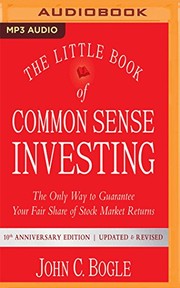 The little book of common sense investingJohn C. BogleA grandfatherly masterclass in cutting through financial noise to find peace of mind and long-term wealth.
 When Genius FailedRoger LowensteinA gripping autopsy of intellectual hubris where the smartest guys in the room mathematically guarantee their own spectacular ruin.