Books › Chaos

Chaos
making a new science
First published 1987 · 496 pages
A dizzying, paradigm-shifting journey that reveals the breathtaking mathematical poetry hidden within the messiness of the natural world.
What it feels like
Reading this book feels like putting on a new pair of glasses and suddenly seeing the secret architecture of the universe. It moves at a brisk, narrative-driven pace, reading less like a dry textbook and more like a thrilling intellectual detective story. The prose is incredibly lucid, translating the dizzying complexities of nonlinear dynamics and fractals into vivid, accessible metaphors that linger in the mind long after the final page. There is a palpable sense of awe and reverence that permeates the text, creating a mood that is both intellectually stimulating and deeply revelatory. It is the perfect read for curious minds who want to experience the thrill of a scientific revolution and look at clouds, coastlines, and dripping faucets with a renewed sense of wonder.
- Mood
- mind-expanding
- revelatory
- intellectually stimulating
- Tone
- lucid
- enthusiastic
- reverent
- journalistic
- Pace
- brisk
- Themes
- hidden order in nature · scientific paradigm shifts · interconnectedness of all things · the beauty of complexity
- The writing
- Vivid and accessible, relying on striking visual metaphors and narrative momentum to translate dense mathematics into gripping storytelling.
- The arc
- Begins with the disorienting unpredictability of the natural world and builds to a profound, awe-inspiring appreciation for its underlying mathematical elegance.
- Who it's for
- Inquisitive readers who love having their perspective of the everyday world fundamentally altered by elegant scientific concepts.
About the book
The author describes how scientists studying the growth of complexity in nature are discovering order and pattern in chaos. He explains concepts such as nonlinearity, the Butterfly Effect, universal constants, fractals, and strange attractors, and examines the work of scientists such as Mitchell J. Feigenbaum, Edward Lorenz, and Benoit Mandelbrot.
Description from Open Library.
Books like Chaos
See why they match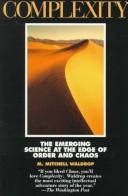 ComplexityM. Mitchell WaldropAn exhilarating intellectual journey into the minds of the maverick scientists who sought the hidden order behind chaos.
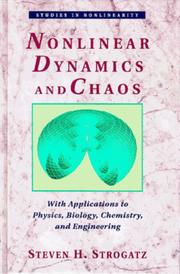 Nonlinear dynamics and ChaosSteven StrogatzAn enthusiastic, deeply intuitive journey into the mathematical heartbeat of the universe, revealing the hidden order inside apparent randomness.
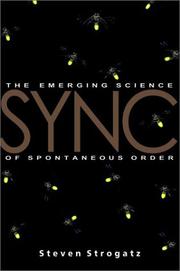 SyncSteven StrogatzA mind-expanding journey that reveals the hidden, elegant choreography connecting fireflies, heartbeats, and the cosmos.
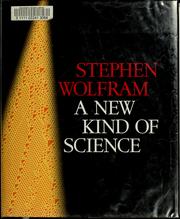 A new kind of scienceStephen WolframA monumental, paradigm-shifting journey that asks you to see the entire universe as a series of simple, unfolding computations.
 Complexity: A Guided TourMelanie MitchellAn illuminating journey that transforms how you see the hidden patterns connecting ant colonies, human brains, and the global economy.
 EmergenceSteven JohnsonA mind-expanding exploration that reveals the hidden, bottom-up rules governing everything from ant colonies to bustling cities.