Books › Game Theory

Game Theory
First published 1991 · 604 pages
A rigorous, deeply analytical journey into the mathematical architecture of human strategy and competition.
What it feels like
Reading this foundational text feels like stepping into a brightly lit, impeccably organized laboratory of human behavior. The atmosphere is intensely cerebral and structured, demanding a slow, methodical pace as you unpack dense mathematical proofs and intricate logical models. It is not a book that sweeps you away on a narrative tide; rather, it anchors you in a world of pure, rigorous analysis where every strategic choice and competitive interaction is distilled into elegant equations. The prose is direct and unadorned, serving entirely as a vehicle for complex ideas. It will deeply satisfy graduate students and analytical thinkers who find beauty in precision, offering a profound sense of intellectual mastery over the mechanics of decision-making and rational self-interest.
- Mood
- cerebral
- structured
- intellectual
- focused
- Tone
- analytical
- rigorous
- objective
- direct
- academic
- Pace
- steady
- Themes
- strategic decision-making · rational behavior · mathematical modeling · competitive dynamics · predicting outcomes
- The writing
- Highly technical and mathematically rigorous, prioritizing clarity and precision over stylistic flourish.
- The arc
- Transitions from foundational curiosity to a deep, intellectually demanding mastery of complex strategic interactions.
- Who it's for
- Graduate students and researchers in economics or political science who crave a comprehensive, mathematically demanding foundation in strategic modeling.
About the book
This advanced text introduces the principles of noncooperative game theory in a direct and uncomplicated style that will acquaint students with the broad spectrum of the field while highlighting and explaining what they need to know at any given point.
This advanced text introduces the principles of noncooperative game theory—including strategic form games, Nash equilibria, subgame perfection, repeated games, and games of incomplete information—in a direct and uncomplicated style that will acquaint students with the broad spectrum of the field while highlighting and explaining what they need to know at any given point. The analytic material is accompanied by many applications, examples, and exercises. The theory of noncooperative games studies the behavior of agents in any situation where each agent's optimal choice may depend on a forecast of the opponents' choices. "Noncooperative" refers to choices that are based on the participant's perceived selfinterest. Although game theory has been applied to many fields, Fudenberg and Tirole focus on the kinds of game theory that have been most useful in the study of economic problems. They also include some applications to political science. The fourteen chapters are grouped in parts that cover static games of complete information, dynamic games of complete information, static games of incomplete information, dynamic games of incomplete information, and advanced topics. source:
Description from Open Library.
Books like Game Theory
See why they match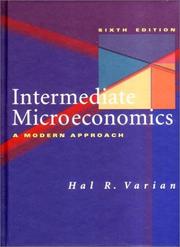 Intermediate microeconomicsHal R. VarianA rigorous, clarifying lens that transforms the messy world of human choices into elegant mathematical models.
 Theory of games and economic behaviorJohn Von NeumannA monumental, intellectually demanding architecture of logic that reshapes how you perceive human decision-making.
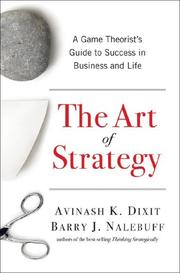 The Art of StrategyAvinash K. DixitA playful, mind-expanding toolkit that transforms the chaotic world of human interaction into a series of solvable puzzles.
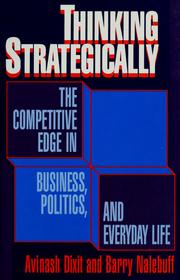 Thinking StrategicallyAvinash K. Dixit; Barry J. NalebuffAn analytical yet accessible guide that transforms the complex math of game theory into a practical lens for everyday decision-making.
 MicroeconomicsRobert S. Pindyck and Daniel L. RubinfeldA rigorous, clarifying lens that transforms the chaos of human commerce into elegant, predictable models.
 The evolution of cooperationRobert AxelrodA lucid, intellectually thrilling exploration that uses mathematics to prove why being nice is actually a winning strategy.