Books › Gödel's proof

Gödel's proof
First published 1959 · 218 pages
A lucid, step-by-step ascent into one of the most mind-bending paradoxes in human thought.
What it feels like
Reading this book feels like being guided up a steep, intellectual mountain by the world's most patient and articulate sherpas. The pace is steady and deliberate, demanding your full attention as it lays down the foundational bricks of formal logic before pulling the rug out from under you. The mood is deeply cerebral yet profoundly illuminating, wrapping the reader in the quiet thrill of pure mathematical discovery. Its prose is a masterclass in clarity, stripping away impenetrable academic jargon to reveal the elegant, dizzying beauty of paradox and truth. It is a perfect fit for armchair philosophers, logic puzzle enthusiasts, and anyone who delights in having their mind expanded by the sheer power of human reasoning.
- Mood
- cerebral
- illuminating
- awe-inspiring
- Tone
- lucid
- patient
- intellectual
- earnest
- Pace
- steady
- Themes
- the limits of formal logic · paradox and truth · the foundations of mathematics · intellectual discovery
- The writing
- Exceptionally clear and precise, translating dense mathematical notation into elegant, accessible prose.
- The arc
- Begins with grounded, foundational concepts and builds toward a dizzying, paradigm-shifting epiphany about the nature of truth.
- Who it's for
- Armchair philosophers and intellectually curious readers eager to grapple with profound concepts without drowning in academic jargon.
About the book
In 1931 Kurt Godel published his fundamental paper, "On Formally Undecidable Propositions of "Principia Mathematica" and Related Systems." This revolutionary paper challenged certain basic assumptions underlying much research in mathematics and logic. Godel received public recognition of his work in 1951 when he was awarded the first Albert Einstein Award for achievement in the natural sciences--perhaps the highest award of its kind in the United States. The award committee described his work in mathematical logic as "one of the greatest contributions to the sciences in recent times."
However, few mathematicians of the time were equipped to understand the young scholar's complex proof. Ernest Nagel and James Newman provide a readable and accessible explanation to both scholars and non-specialists of the main ideas and broad implications of Godel's discovery. It offers every educated person with a taste for logic and philosophy the chance to understand a previously difficult and inaccessible subject.
With a new introduction by Douglas R. Hofstadter, this book will appeal students, scholars, and professionals in the fields of mathematics, computer science, logic and philosophy, and science.
Description from Open Library.
Books like Gödel's proof
See why they match Is God a mathematician?Mario LivioA contemplative journey through history and logic that asks whether the universe is fundamentally built on numbers.
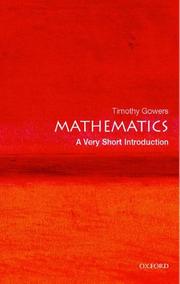 MathematicsTimothy GowersA patient, mind-expanding glimpse into the elegant, abstract world of advanced mathematics.
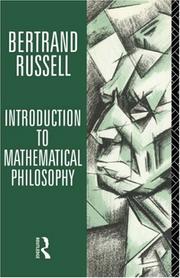 Introduction to mathematical philosophyBertrand RussellAn intellectual exploration that peels back the familiar layers of numbers to reveal the philosophical bedrock beneath.
 Mathematics and the ImaginationEdward Kasner and James Roy NewmanA playful journey to the edges of human logic, where numbers become puzzles and infinity feels within reach.
 One, two, three ... infinityGeorge GamowA playful, mind-expanding romp through the fundamental laws of the universe that makes complex science feel like an inviting puzzle.
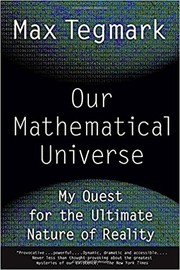 Our Mathematical UniverseMax TegmarkA dizzying, enthusiastic plunge into the radical idea that the cosmos isn't just described by math, but is made of it.