Books › Hominids

Hugo Award for Best Novel 2003
Hominids
First published 2002 · 448 pages
A thoughtful anthropological thought experiment that holds a mirror up to humanity through the eyes of a parallel-universe Neanderthal.
What it feels like
Reading this book feels like stepping into a fascinating, late-night philosophical debate about what it means to be human. The narrative unfolds at a steady, deliberate pace, balancing the intellectual thrill of a scientific puzzle with the emotional weight of cross-cultural connection. The prose is clear and accessible, acting as a transparent window into a meticulously crafted parallel world where Neanderthals survived and thrived. It is an earnest, optimistic exploration of society, ecology, and morality, contrasting our own flaws with a utopian alternative. Fans of anthropological science fiction and thought-provoking alternate histories will devour this hopeful, inquisitive journey that moves from profound isolation to the warmth of unexpected friendship and understanding.
- Mood
- intellectual
- wondrous
- hopeful
- reflective
- Tone
- earnest
- inquisitive
- philosophical
- optimistic
- Pace
- steady
- Themes
- cultural relativism · nature of humanity · parallel evolution · environmental stewardship · cross-cultural connection
- The writing
- Clear, accessible, and dialogue-heavy, prioritizing the exploration of complex ideas over stylistic flourish.
- The arc
- Moves from profound disorientation and isolation to a warm, hopeful sense of cross-cultural understanding.
- Who it's for
- Readers who love anthropological thought experiments and optimistic, idea-driven science fiction.
Content notes
- sexual assault
- trauma recovery
- courtroom tension
About the book
From back cover Tor paperback February 2003:
Hominids examines two unique species of people. We are one of those species; the other is the Neanderthals of a parallel world where they became the dominant intelligence. The Neanderthal civilization has reached heights of culture and science comparable to our own, but with radically different history, society and philosophy.
Ponter Boddit, a Neanderthal physicist, accidentally pierces the barrier between worlds and is transferred to our universe. Almost immediately recognized as a Neanderthal, but only much later as a scientist, he is quarantined and studied, alone and bewildered, a stranger in a strange land. But Ponter is also befriended -- by a doctor and a physicist who share his questing intelligence, and especially by Canadian geneticist Mary Vaughan, a woman with whom he develops a special rapport.
Ponter's partner, Adikor Huld, finds himself with a messy lab, a missing body, suspicious people all around and an explosive murder trial. How can he possibly prove his innocence when he has no idea what actually happened to Ponter?
Description from Open Library.
Books like Hominids
See why they match HybridsRobert J. SawyerA thoughtful, idea-driven exploration of what it means to be human, wrapped in a cross-dimensional romance and high-stakes scientific crisis.
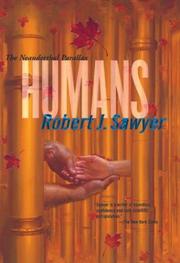 HumansRobert J. SawyerA thoughtful, empathetic exploration of humanity viewed through the mirror of a parallel, peaceful Neanderthal society.
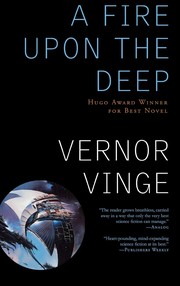 A Fire upon the DeepVernor VingeA mind-bending plunge into a universe where the laws of physics and intelligence shift across the stars, blending cosmic horror with a desperate rescue mission.
 DarwiniaRobert Charles WilsonAn Edwardian expedition into an alien wilderness that slowly unravels the very fabric of reality.
 The Uplift WarDavid BrinA sprawling, inventive space opera that blends high-stakes guerrilla warfare with deep philosophical questions about what it means to be sentient.
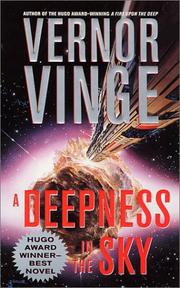 A Deepness in the Sky (Zones of Thought)Vernor VingeA sweeping, intellectually massive space opera that pits the resilience of the free mind against the terrifying efficiency of absolute control.