Books › In Pursuit of the Unknown
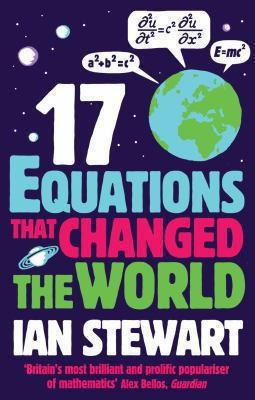
In Pursuit of the Unknown
17 Equations That Changed the World
493 pages
A fascinating, accessible tour through the invisible mathematical scaffolding that holds up our modern world.
What it feels like
Reading this book feels like being handed a pair of X-ray glasses that reveal the hidden architecture of reality. It moves at a steady, episodic pace, allowing you to linger on each intellectual breakthrough before moving to the next. The mood is deeply curious and expansive, replacing the dry rote memorization of high school math with a profound sense of awe. The prose is remarkably lucid and enthusiastic, acting as a friendly guide through complex historical and scientific landscapes without ever talking down to the reader. It is a deeply satisfying experience for anyone who loves connecting the dots between abstract ideas and the tangible world, offering a thrilling glimpse into the human ingenuity that built the modern age.
- Mood
- illuminating
- curious
- expansive
- awe-inspiring
- Tone
- enthusiastic
- accessible
- erudite
- lucid
- Pace
- steady
- Themes
- the hidden architecture of reality · human ingenuity · interconnectedness of knowledge · the power of abstraction · technological progress
- The writing
- Clear, conversational, and elegantly structured to demystify complex concepts without sacrificing their inherent wonder.
- The arc
- Begins with simple curiosity about familiar concepts and builds to a profound sense of awe at the invisible mathematical scaffolding of the universe.
- Who it's for
- Curious non-experts and science enthusiasts who want to peek behind the curtain of reality to see the gears turning.
About the book
In In Pursuit of the Unknown, celebrated mathematician Ian Stewart uses a handful of mathematical equations to explore the vitally important connections between math and human progress. We often overlook the historical link between mathematics and technological advances, says Stewart--but this connection is integral to any complete understanding of human history. Equations are modeled on the patterns we find in the world around us, says Stewart, and it is through equations that we are able to make sense of, and in turn influence, our world. Stewart locates the origins of each equation he presents--from Pythagoras's Theorem to Newton's Law of Gravity to Einstein's Theory of Relativity--within a particular historical moment, elucidating the development of mathematical and philosophical thought necessary for each equation's discovery. None of these equations emerged in a vacuum, Stewart shows; each drew, in some way, on past equations and the thinking of the day. In turn, all of these equations paved the way for major developments in mathematics, science, philosophy, and technology. Without logarithms (invented in the early 17th century by John Napier and improved by Henry Briggs), scientists would not have been able to calculate the movement of the planets, and mathematicians would not have been able to develop fractal geometry. The Wave Equation is one of the most important equations in physics, and is crucial for engineers studying the vibrations in vehicles and the response of buildings to earthquakes. And the equation at the heart of Information Theory, devised by Claude Shannon, is the basis of digital communication today. An approachable and informative guide to the equations upon which nearly every aspect of scientific and mathematical understanding depends, In Pursuit of the Unknown is also a reminder that equations have profoundly influenced our thinking and continue to make possible many of the advances that we take for granted.
Description from Open Library.
Books like In Pursuit of the Unknown
See why they match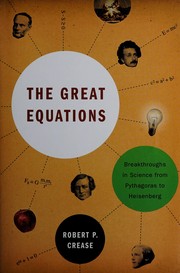 The great equationsRobert P. CreaseA panoramic journey through the history of science that treats mathematical equations as profound works of art.
 Is God a mathematician?Mario LivioA contemplative journey through history and logic that asks whether the universe is fundamentally built on numbers.
 Euclid's WindowLeonard MlodinowA witty, mind-expanding journey that transforms abstract mathematics into a thrilling story of human discovery.
 Fermat's Last TheoremSimon SinghA centuries-spanning intellectual thriller that makes the pursuit of a mathematical proof feel like a high-stakes treasure hunt.
 The great unknownMarcus du SautoyA whirlwind, deeply personal tour through the profound mysteries and outer limits of human knowledge.
 A History of π (PI)Petr BeckmannAn accessible, opinionated journey through human history, viewed through the lens of a single, infinite number.