Books › Introductory Mathematical Analysis

Introductory Mathematical Analysis
First published 1996 · 1131 pages
A rigorous, clear-eyed foundation in the mathematical tools that drive economic and business analysis.
What it feels like
Reading this book feels like stepping into a quiet, well-lit study carrel with a freshly sharpened pencil and a blank pad of graph paper. It is a deeply structured, methodical experience that demands focus and rewards patience. The atmosphere is purely academic and pragmatic, stripping away the noise of theoretical abstraction to focus on how numbers actually behave in the worlds of business and economics. There is a distinct rhythm to the text, a steady, logical progression from concept to formula to practical application. It delights the pragmatic student who craves clarity over flourish, offering the quiet, hard-won satisfaction that comes when a complex equation finally balances and a difficult concept clicks into place.
- Mood
- academic
- focused
- structured
- rigorous
- Tone
- objective
- instructional
- pragmatic
- authoritative
- Pace
- steady
- Themes
- quantitative reasoning · practical application · logical progression · problem-solving
- The writing
- Precise and methodical, stripping away ambiguity to deliver clear, step-by-step logical instruction.
- The arc
- The reader moves from the daunting challenge of abstract concepts to the quiet satisfaction of mathematical mastery.
- Who it's for
- Business and economics students who need a reliable, no-nonsense guide to mastering applied mathematics.
About the book
"Laurel Technical Services."
Title on computer disk: "Explorations in finite mathematics and visual calculus."
System requirements for computer disk: IBM PC with at least 640K of memory.
Description from Open Library.
Books like Introductory Mathematical Analysis
See why they match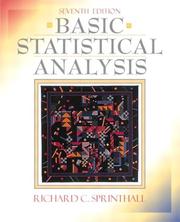 Basic statistical analysisRichard C. SprinthallA structured, methodical journey into the quantitative tools and multivariate analyses that underpin the social sciences.
 Introduction to business statisticsAlan H. Kvanli, Robert J. Pavur and othersA structured, pragmatic journey through the foundational tools of data analysis and quantitative decision-making.
 Statistical techniques in business and economicsRobert Deward MasonA methodical, clear-eyed exploration of the mathematical tools that drive modern economic and business decisions.
- Statistics for management and economicsWilliam MendenhallA rigorous, methodical immersion into the foundational tools of quantitative analysis and data-driven decision making.
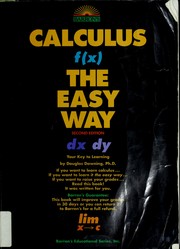 Calculus the easy wayDouglas DowningA whimsical fantasy adventure that sneaks up on you and teaches you the fundamental principles of calculus along the way.
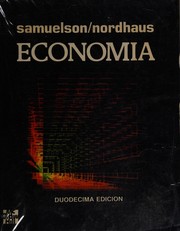 Economics, an introductory analysisSAMUELSON,A rigorous, foundational journey that transforms the chaotic noise of global markets into a structured, comprehensible system of incentives and forces.