Books › Measuring behaviour

Measuring behaviour
an introductory guide
First published 1986 · 222 pages
A reassuring, pragmatic toolkit that transforms the daunting task of scientific observation into an accessible, masterable skill.
What it feels like
Reading this guide feels like sitting down with a patient, experienced mentor who is determined to demystify the scientific process. The pace is steady and deliberate, designed to build confidence rather than overwhelm. Instead of drowning the reader in dense academic jargon, the prose is refreshingly clear, concise, and deeply pragmatic. The mood is one of focused curiosity and methodical rigor, creating an atmosphere where the daunting prospect of data collection suddenly feels manageable. It traces an arc from initial apprehension to grounded capability, offering a reassuring hand to students stepping into the field for the first time. This is a foundational text that delights biology and psychology researchers looking for a straightforward, no-nonsense roadmap to observing the natural world.
- Mood
- academic
- focused
- methodical
- Tone
- instructive
- encouraging
- pragmatic
- authoritative
- Pace
- steady
- Themes
- scientific rigor · the art of observation · demystifying research · practical methodology
- The writing
- Clear, concise, and highly accessible, prioritizing practical understanding over dense academic jargon.
- The arc
- Moves from the overwhelming apprehension of starting a research project to a grounded sense of methodological confidence.
- Who it's for
- Undergraduate and graduate students in biology or psychology who need a straightforward, reassuring guide to conducting their first behavioral studies.
Content notes
- animal research methodology
About the book
This new edition of Measuring Behaviour is a guide to the principles and methods of quantitative studies of behaviour, with an emphasis on techniques of direct recording and analysis. All sections have been updated, the sections on statistical analysis and research design have been greatly expanded. Those attempting to measure behaviour for the first time are often appalled by the apparent difficulty of the job. Measuring behaviour is a skill, but one which can be mastered given some basic knowledge. The purpose of this book is to provide that basic knowledge in a succinct and easily understood form. Aimed primarily at undergraduate and graduate students in biology and psychology who are about to embark upon behavioural research projects, this book provides a concise review of methodology that will also be of great value to professional scientists of all disciplines in which behaviour is measured. Principles and techniques are explained clearly in simple and concise language. -- from back cover.
Description from Open Library.
Books like Measuring behaviour
See why they match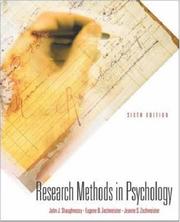 Research methods in psychologyJohn ShaughnessyA rigorous, structured journey into the mechanics of how we scientifically study the human mind.
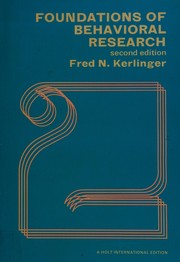 Foundations of behavioral researchFred N. KerlingerA rigorous, encyclopedic anchor for navigating the complex waters of social science research.
 The principles of learning and behaviorMichael DomjanA rigorous, foundational journey into the mechanics of how creatures acquire knowledge and adapt their actions.
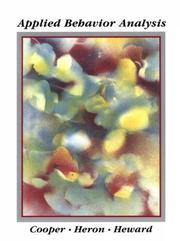 Applied behavior analysisJohn O. CooperA rigorous, encyclopedic deep dive into the mechanics of human behavior and the empirical science of learning.
 Experimental design in behavioural researchK. D. BrootaA rigorous, structured immersion into the mechanics of behavioral research and experimental design.
 Psychometric theoryJum C. NunnallyA comprehensive, authoritative dive into the mechanics of measurement and statistical inference.