Books › Programming Erlang
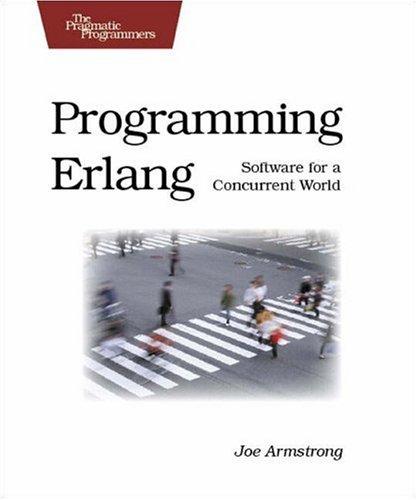
Programming Erlang
Software for a Concurrent World
536 pages
An authoritative, hands-on journey into mastering concurrent programming, guided by the creator of the language himself.
What it feels like
Reading this book feels like sitting down with a master craftsman who is eager to demystify a complex tool. The pace is steady and deliberate, guiding you through small, manageable steps before scaling up to industrial-strength concepts. The mood is highly focused and intellectually stimulating, replacing the typical frustration of parallel programming with a sense of structured empowerment. The prose is clear, practical, and packed with real-world tutorials, insider tips, and hands-on exercises that build confidence. It is an encouraging, authoritative experience designed for developers who want to move beyond sequential thinking and effortlessly tackle the hard problems of concurrent, multicore environments.
- Mood
- focused
- intellectually stimulating
- structured
- Tone
- authoritative
- encouraging
- instructional
- practical
- Pace
- steady
- Themes
- mastering concurrency · system scaling · problem-solving · technical empowerment
- The writing
- Clear, step-by-step, and packed with practical examples and insider advice from the language's creator.
- The arc
- Moves from foundational curiosity to the confident mastery of complex, parallel systems.
- Who it's for
- Programmers and developers looking to confidently tackle parallel processing and build scalable, concurrent applications.
About the book
A multi-user game, web site, cloud application, or networked database can have thousands of users all interacting at the same time. You need a powerful, industrial-strength tool to handle the really hard problems inherent in parallel, concurrent environments. You need Erlang. In this second edition of the bestselling Programming Erlang, you'll learn how to write parallel programs that scale effortlessly on multicore systems.
Using Erlang, you'll be surprised at how easy it becomes to deal with parallel problems, and how much faster and more efficiently your programs run. That's because Erlang uses sets of parallel processes-not a single sequential process, as found in most programming languages.
Joe Armstrong, creator of Erlang, introduces this powerful language in small steps, giving you a complete overview of Erlang and how to use it in common scenarios. You'll start with sequential programming, move to parallel programming and handling errors in parallel programs, and learn to work confidently with distributed programming and the standard Erlang/Open Telecom Platform (OTP) frameworks.
You need no previous knowledge of functional or parallel programming. The chapters are packed with hands-on, real-world tutorial examples and insider tips and advice, and finish with exercises for both beginning and advanced users.
The second edition has been extensively rewritten. New to this edition are seven chapters covering the latest Erlang features: maps, the type system and the Dialyzer, WebSockets, programming idioms, and a new stand-alone execution environment. You'll write programs that dynamically detect and correct errors, and that can be upgraded without stopping the system. There's also coverage of rebar (the de facto Erlang build system), and information on how to share and use Erlang projects on github, illustrated with examples from cowboy and bitcask.
Erlang will change your view of the world, and of how you program.
Description from Open Library.
Books like Programming Erlang
See why they match Elixir in actionSaša JuricA pragmatic, eye-opening journey into building systems that simply do not fail, reshaping how you think about concurrency.
 Effective PythonBrett SlatkinA clarifying mentor in book form that transforms clunky code into elegant, native solutions.
 Programming in LuaRoberto IerusalimschyAn authoritative, steadily paced journey into the mechanics of a versatile scripting language, guided by its chief architect.
 97 Things Every Programmer Should KnowKevlin HenneyA chorus of veteran mentors offering bite-sized, hard-won wisdom to elevate your daily coding practice.
 Clojure programmingChas EmerickA rigorous but rewarding journey that rewires your brain to think in elegant, functional abstractions.
 Eloquent JavascriptMarijn HaverbekeA beautifully crafted, philosophical journey into the heart of web programming that treats code as a medium of expression.