Books › Shenzhen

Shenzhen
152 pages
A wry, quietly lonely portrait of expatriate life in a rapidly changing, unfamiliar city.
What it feels like
Reading this graphic memoir feels like sitting in an anonymous hotel room halfway across the world, watching a strange city hum outside your window. The pace is decidedly meandering, driven not by plot but by the quiet, repetitive rhythms of daily expatriate life and the slow accumulation of cultural observations. The creator's voice is wonderfully dry and self-deprecating, turning moments of profound isolation and communication breakdown into scenes of gentle, absurd comedy. Through clean, expressive artwork and understated narration, the book captures the specific, melancholic texture of being a stranger in a strange land. It is a perfect read for armchair travelers and fans of slice-of-life stories who delight in wry humor, quiet contemplation, and the awkward realities of globalization.
- Mood
- alienating
- contemplative
- quietly absurd
- lonely
- Tone
- wry
- observant
- self-deprecating
- detached
- Pace
- meandering
- Themes
- cultural isolation · the absurdity of globalization · communication barriers · expat loneliness · finding humor in the mundane
- The writing
- The narration is dry and understated, perfectly complementing the clean, expressive, and gently realistic cartooning.
- The arc
- The narrative drifts from disoriented culture shock to a wry, comfortable resignation with the absurdities of temporary expatriate life.
- Who it's for
- Armchair travelers and fans of slice-of-life comics who appreciate dry humor and quiet observations about cultural displacement.
Content notes
- isolation
About the book
From Publishers Weekly Last year's Pyongyang introduced Delisle's acute voice, as he reported from North Korea with unusual insight and wit, not to mention wonderfully detailed cartooning. Shenzhen is not a follow-up so much as another installment in what one hopes is an ongoing series of travelogues by this talented artist. Here he again finds himself working on an animated movie in a Communist country, this time in Shenzhen, an isolated city in southern China. Delisle not only takes readers through his daily routine, but also explores Chinese custom and geography, eloquently explaining the cultural differences city to city, company to company and person to person. He also goes into detail about the food and entertainment of the region as well as animation in general and his own career path. All of this is the result of his intense isolation for three months in an anonymous hotel room. He has little to do but ruminate on his surroundings, and readers are the lucky beneficiaries of his loneliness. As in his earlier work, Delisle draws in a gentle cartoon style: his observations are grounded in realism, but his figures are light cartoons, giving the book, as Delisle himself remarks, a feeling of an alternative Tintin. (Oct.) Copyright © Reed Business Information, a division of Reed Elsevier Inc. All rights reserved.
From Booklist Delisle's Pyongyang (2005) documented two months spent overseeing cartoon production in North Korea's capital. Now he recounts a 1997 stint in the Chinese boomtown Shenzhen. Even a decade ago, China showed signs of Westernization, at least in Special Economic Zones such as Shenzhen, where Delisle found a Hard Rock Cafe and a Gold's Gym. Still, he experienced near-constant alienation. The absence of other Westerners and bilingual Chinese left him unable to ask about baffling cultural differences ranging from exotic shops to the pervasive lack of sanitation. Because China is an authoritarian, not totalitarian, state, and Delisle escaped the oppressive atmosphere with a getaway to nearby Hong Kong, whose relative familiarity gave him "reverse culture shock," Delisle's wittily empathetic depiction of the Western-Chinese cultural gap is less dramatic than that of his Korean sojourn. That said, his creative skill suggests that the comic strip is the ideal medium for such an account. His wry drawings and clever storytelling convey his experiences far more effectively than one imagines a travel journal or film documentary would. Gordon Flagg Copyright © American Library Association. All rights reserved
Description from Open Library.
Books like Shenzhen
See why they match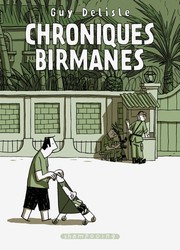 Chroniques birmanesGuy DelisleA wry, quietly observant graphic travelogue that finds the profound and the absurd in the daily rhythms of life under a military dictatorship.
 PyongyangGuy DelisleA wry, starkly drawn journey into the surreal and claustrophobic heart of a modern totalitarian state.
 DisplacementLucy KnisleyA tender, watercolor-washed journey through the choppy waters of caregiving, memory, and generational love.
 Rolling BlackoutsSarah GliddenA quietly devastating, watercolor-washed exploration of the ethics of journalism and the human echoes of war.
 The Arab of the futureRiad SattoufA visually striking and candid graphic memoir that filters the chaos of political idealism and cultural displacement through the wide eyes of a nomadic child.
 EpilepticDavid B.A sprawling, heavily inked descent into the labyrinth of family trauma, where childhood illness takes the shape of literal monsters.