Books › The Foundation Trilogy

The Foundation Trilogy
938 pages
A sweeping, cerebral puzzle-box of a saga that spans millennia and treats the rise and fall of empires as a mathematical equation to be solved.
What it feels like
Reading this trilogy feels like stepping into a grand, cosmic chess match where the board spans galaxies and the game takes centuries to play out. The experience is deeply cerebral, driven not by explosive action or intimate character studies, but by the sheer thrill of ideas and political maneuvering. The prose is famously utilitarian and dialogue-heavy, serving as a clear glass window into complex philosophical debates about the cyclical nature of history and the power of intellect over brute force. It moves at a steady, deliberate pace, leaping across generations to watch seeds of strategy bloom into societal shifts. It is a perfect fit for readers who love massive scale, systemic problem-solving, and the awe-inspiring feeling of watching a meticulously crafted puzzle snap into place across the millennia.
- Mood
- cerebral
- sweeping
- awe-inspiring
- grand
- Tone
- analytical
- philosophical
- detached
- earnest
- Pace
- steady
- Themes
- the cyclical nature of history · intellect over violence · the fragility of civilization · technological determinism · the burden of foresight
- The writing
- Utilitarian, dialogue-driven, and unadorned, prioritizing the clear delivery of complex ideas over aesthetic flourish.
- The arc
- Moves from a sense of inevitable decline and intellectual certainty into unpredictable chaos, culminating in a renewed, cautious hope for the future.
- Who it's for
- Readers who love massive scale, political maneuvering, and philosophical thought experiments over intimate character-driven drama.
Content notes
- off-page violence
- political manipulation
About the book
Foundation - Foundation and Empire - Second Foundation
Isaac Asimov's Foundation novels are some of the great masterworks of science fiction. Unsurpassed for their unique blend of nonstop action, daring ideas, and extensive world-building, they chronicle the struggle of a courageous group of men and women working to preserve humanity’s light against an inexorable tide of darkness and violence.
Led by its founding father, the great psychohistorian Hari Seldon, and taking advantage of its superior science and technology, the Foundation has survived the greed and barbarism of its neighboring warrior-planets. Yet now it must face the Empire—still the mightiest force in the Galaxy even in its death throes. When an ambitious general determined to restore the Empire’s glory turns the vast imperial fleet toward the Foundation, the only hope for the small planet of scholars and scientists lies in the prophecies of Hari Seldon.
But not even Hari Seldon could have predicted the birth of the extraordinary creature called The Mule, a mutant intelligence with a power greater than a dozen battle fleets... a power that can turn the strongest-willed human into an obedient slave.
Description from Open Library.
Books like The Foundation Trilogy
See why they match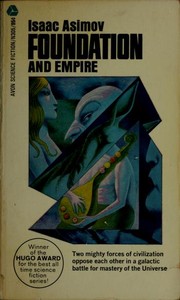 Foundation and EmpireIsaac AsimovA sweeping, cerebral game of galactic chess where the board is history itself and the rules are suddenly, terrifyingly changing.
 Second FoundationIsaac AsimovA cerebral game of galactic chess where the most dangerous weapons are hidden thoughts and mathematical probabilities.
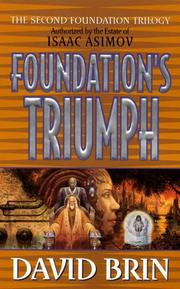 Foundation's TriumphDavid BrinA sweeping, philosophical victory lap that wrestles with the ethics of shaping human destiny across the stars.
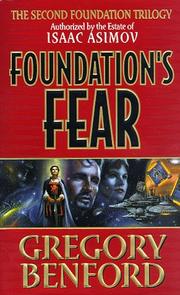 Foundation's FearGregory BenfordA dense, cerebral journey into the bureaucratic and technological heart of a decaying galactic empire.
 Foundation and ChaosGreg BearA cerebral, sweeping space opera that wrestles with the ethics of artificial intelligence and the heavy burden of predicting the future.
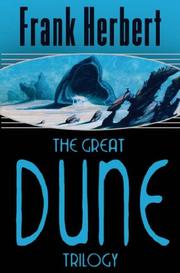 The Great Dune TrilogyFrank HerbertA sweeping, sand-swept epic of political intrigue and mystical destiny that demands total immersion.