Books › The Physics of Immortality

The Physics of Immortality
560 pages
A dizzying, audacious leap from the rigorous equations of quantum mechanics to the ultimate resurrection of humanity.
What it feels like
Reading this book feels like sitting in a late-night, mind-expanding university seminar where the boundaries between hard physics and theology completely dissolve. The pace is steady and demanding, requiring the reader to grapple with dense scientific concepts, but the payoff is a dizzying, awe-inspiring vision of the cosmos. The mood is deeply cerebral yet surprisingly hopeful, anchored by an earnest, audacious tone that dares to prove the divine through mathematics. The prose is analytical and uncompromising, weaving together computer science, cosmology, and evolutionary biology into a grand, speculative tapestry. It is a perfect fit for armchair philosophers, transhumanists, and science enthusiasts who delight in provocative, boundary-pushing theories about the ultimate fate of the universe and human consciousness.
- Mood
- mind-bending
- awe-inspiring
- speculative
- cerebral
- Tone
- audacious
- earnest
- analytical
- provocative
- didactic
- Pace
- steady
- Themes
- intersection of science and faith · ultimate fate of the universe · technological resurrection · search for ultimate meaning · cosmic eschatology
- The writing
- Dense and highly analytical, blending complex mathematical concepts with sweeping philosophical declarations.
- The arc
- Moves from rigorous, grounded scientific inquiry into dizzying, awe-inspiring realms of cosmic speculation and ultimate hope.
- Who it's for
- Armchair physicists and philosophical thinkers who love grappling with grand, controversial theories that bridge the gap between hard science and theology.
Content notes
- existential themes
- discussions of death and mortality
About the book
Frank J. Tipler is a major theoretician in the field of global general relativity, the rarefied branch of physics created by Stephen Hawking and Roger Penrose. Like most modern scientists, Tipler was an atheist who gave little thought to questions of theology.
Yet, in devising a mathematical model of the end of the universe, Tipler came to a stunning conclusion: Using the most advanced and sophisticated methods of modern physics, relying solely on the rigorous procedures of logic that science demands, he had created a proof of the existence of God.
Tipler's model of the universal end-time is called the Omega Point Theory. For the last seventeen years, Tipler has explored the implications of the Omega Point Theory, one of which is even more astonishing than the evidence of God's existence: It is not only possible, but likely, that every human being who ever lived will be resurrected from the dead.
As Tipler writes in his preface, he arrived at his proofs of God and immortality "in exactly the same way physicists calculate the properties of the electron.".
In The Physics of Immortality Tipler guides the general reader through the details of his exhilarating discoveries. Displaying an awesome command of disciplines as diverse as computer science, economics, particle physics, cosmology, and evolutionary biology, Tipler constructs a stunningly plausible argument for God and the universal resurrection.
Lucid in style, audacious in aim, breathtaking in scope, powerfully argued, and, finally, deeply moving, this is a book that will change the way you think. No reader, whether skeptic or believer, will look at the universe in the same way after encountering this remarkable work.
Description from Open Library.
Books like The Physics of Immortality
See why they match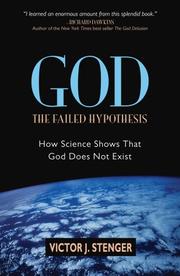 GodVictor J. StengerA methodical, science-driven examination that treats the divine as a testable hypothesis.
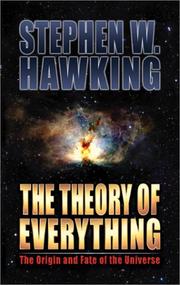 The theory of everythingSTEPHEN W. HAWKINGA mind-expanding journey to the very edges of human understanding, delivered with the clarity of a fireside chat.
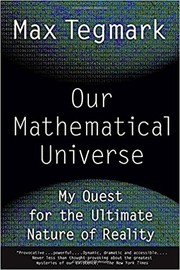 Our Mathematical UniverseMax TegmarkA dizzying, enthusiastic plunge into the radical idea that the cosmos isn't just described by math, but is made of it.
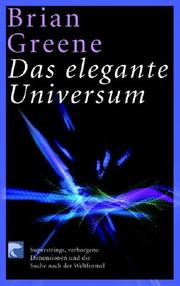 The Elegant UniverseBrian GreeneA mind-expanding journey into the hidden dimensions and fundamental fabric of reality that leaves you staring in awe at the everyday world.
 A Universe from NothingLawrence M. KraussA witty, mind-bending trip to the edge of the cosmos that dismantles everything you thought you knew about nothingness.
 The Universe in a NutshellStephen HawkingA mind-expanding, accessible journey to the very edges of theoretical physics, guided by a brilliant and witty intellect.