Books › Transport phenomena

Transport phenomena
First published 1960 · 895 pages
A rigorous, foundational journey through the mathematical elegance of how mass, momentum, and energy move through the physical world.
What it feels like
Reading this foundational text feels like climbing a steep, unforgiving intellectual mountain. The pace is necessarily steady, demanding absolute focus as you navigate dense thickets of differential equations and tensor notation. The mood is highly cerebral and structured, presenting the physical world not as a chaotic mess, but as a beautifully ordered system governed by strict conservation laws. For those who persevere through its rigorous, objective prose, the experience offers a deeply satisfying, almost philosophical revelation: the realization that heat, mass, and momentum transfer are all expressions of the same elegant mathematical principles. It is a demanding but profoundly rewarding experience that delights serious engineering students and physicists who crave foundational rigor and the mastery of complex, unified theories.
- Mood
- cerebral
- demanding
- structured
- intellectual
- Tone
- authoritative
- rigorous
- objective
- precise
- academic
- Pace
- steady
- Themes
- unification of physical laws · mathematical modeling · conservation principles · intellectual rigor
- The writing
- Dense, mathematically rigorous, and highly structured, prioritizing absolute clarity and precision over accessibility.
- The arc
- Moves from overwhelming mathematical complexity to a profound, satisfying realization of the unified laws governing physical processes.
- Who it's for
- Dedicated engineering and physics students who crave a deep, foundational understanding of how the physical world operates.
About the book
First published in 1958 under title: Notes on transport phenomena. Bibliographical footnotes.
Description from Open Library.
Books like Transport phenomena
See why they match Fluid mechanicsVictor L. StreeterA rigorous, foundational journey into the mathematical and physical laws governing the flow of liquids and gases.
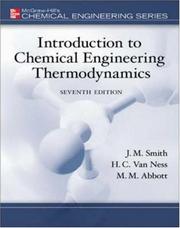 Introduction to chemical engineering thermodynamicsJ. M. SmithA rigorous, foundational journey through the physical laws that govern chemical processes, demanding focus and rewarding it with profound practical mastery.
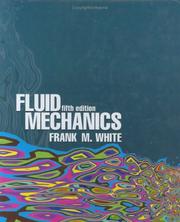 Fluid mechanicsFrank M. WhiteA rigorous, methodical exploration of the physical laws that govern the flow of liquids and gases.
 Physical chemistryP. W. AtkinsA rigorous, intellectually demanding exploration of the mathematical and physical foundations that govern chemical behavior.
 Applied hydrocarbon thermodynamicsWayne C. EdmisterA rigorous, systematic toolkit designed to bring mathematical order to complex process engineering problems.
 Elementary principles of chemical processesRichard M. FelderA clear, methodical dive into the practical realities of chemical engineering.