Books › What is life? The physical aspect of the living cell

What is life? The physical aspect of the living cell
and, Mind and matter.
First published 1944 · 263 pages
A profound, elegant meditation that bridges the gap between cold physics and the warm, breathing mystery of living things.
What it feels like
Reading this foundational text feels like sitting in a quiet, sunlit lecture hall with one of the twentieth century's greatest minds. The pace is steady and deliberate, asking you to slow down and truly digest its elegant thought experiments. It possesses a deeply cerebral yet awe-inspiring mood, shifting seamlessly from the rigorous mechanics of thermodynamics to sweeping philosophical questions about consciousness and free will. The prose is surprisingly conversational and lucid, stripping away academic jargon to reveal the sheer wonder of how order arises from chaos. It is a deeply rewarding experience for curious readers who delight in the intersection of hard science and philosophy, offering a profound sense of intellectual expansion that lingers long after the final page.
- Mood
- cerebral
- contemplative
- awe-inspiring
- expansive
- Tone
- inquiring
- philosophical
- earnest
- lucid
- authoritative
- Pace
- steady
- Themes
- the mystery of consciousness · order from chaos · the physical basis of life · scientific reductionism · the limits of human knowledge
- The writing
- Elegant, conversational, and remarkably lucid, translating complex thermodynamic and biological concepts into accessible thought experiments.
- The arc
- Begins with grounded, methodical curiosity and expands outward into profound, almost spiritual awe at the mechanics of existence.
- Who it's for
- Deep thinkers and science enthusiasts who love tracing the philosophical boundaries where physics, biology, and consciousness collide.
About the book
What Is Life? is a 1944 non-fiction science book written for the lay reader by physicist Erwin Schrödinger. The book was based on a course of public lectures delivered by Schrödinger in February 1943 at Trinity College, Dublin. Schrödinger's lecture focused on one important question: "how can the events in space and time which take place within the spatial boundary of a living organism be accounted for by physics and chemistry?" In the book, Schrödinger introduced the idea of an "aperiodic crystal" that contained genetic information in its configuration of covalent chemical bonds. In the 1950s, this idea stimulated enthusiasm for discovering the genetic molecule and would give both Francis Crick and James Watson initial inspiration in their research.
Description from Open Library.
Books like What is life? The physical aspect of the living cell
See why they match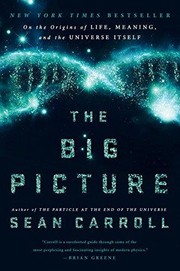 The Big PictureSean CarrollA sweeping, deeply comforting journey from the quantum realm to the human heart, proving that a universe without inherent purpose is still brimming with meaning.
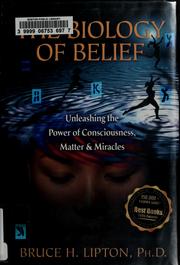 The biology of beliefBruce H. LiptonA paradigm-shifting journey into the microscopic world that proves your thoughts have the power to rewrite your physical reality.
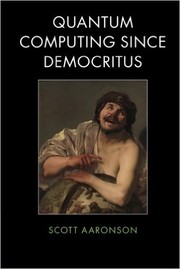 Quantum Computing Since DemocritusScott AaronsonAn informal, mind-expanding tour through the deepest philosophical and scientific questions of computation and reality.
 Meine WeltansichtErwin SchrödingerA deeply cerebral exploration of the metaphysical threads that connect scientific inquiry to the fundamental nature of reality.
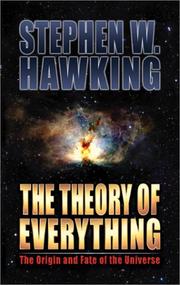 The theory of everythingSTEPHEN W. HAWKINGA mind-expanding journey to the very edges of human understanding, delivered with the clarity of a fireside chat.
 The strangest manGraham FarmeloAn illuminating journey into the brilliant, contradictory mind of one of modern science's most enigmatic figures.