Books › A course in linear models

A course in linear models
422 pages
A rigorous, fast-paced intellectual workout that builds the mathematical scaffolding of statistical theory.
What it feels like
Reading this text feels like embarking on a demanding but deeply rewarding intellectual sprint. Designed for a brisk one-semester pace, it pulls no punches, immersing the reader in a structured, highly focused atmosphere of mathematical rigor. The prose is dense and uncompromisingly precise, stripping away fluff to deliver pure, unadulterated statistical theory. You will find yourself wrestling with idempotent matrices and generalized inverses, moving from the initial friction of complex proofs to the profound satisfaction of structural clarity. It is an experience of building mental architecture. Perfect for graduate students and dedicated statisticians, this is a book that demands your full attention and rewards it with a rock-solid foundation in analytical problem-solving.
- Mood
- intellectual
- focused
- structured
- demanding
- Tone
- academic
- rigorous
- objective
- instructional
- formal
- Pace
- brisk
- Themes
- mathematical foundations · statistical rigor · analytical problem solving · theoretical frameworks
- The writing
- Dense, precise, and highly technical, prioritizing mathematical clarity and logical progression over narrative flair.
- The arc
- Moves from foundational apprehension to the satisfying clarity of mastering complex statistical structures.
- Who it's for
- Graduate students and serious practitioners of statistics who need a rigorous, fast-paced grounding in linear model theory.
About the book
This book would serve as a suitable text for a course in linear models. The Kshirsagar book is specifically designed for a one-semester course, and one would have to move quickly to cover every- thing in that time. This book covers such standard topics as full- and non-full-rank models, the Gauss—Mar- kov theorem, distribution of estimators, distribution of quadratic forms, idempotent matrices, estimability, generalized inverses, confidence re- gions, tests Of linear hypotheses, orthogonal polynomials, one-way and two-way classifications, and analysis of covariance.
Description from Open Library.
Books like A course in linear models
See why they match Biostatistical analysisJerrold H. ZarA rigorous, foundational anchor that transforms daunting numerical data into clear, actionable biological insights.
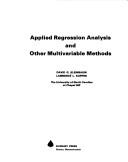 Applied regression analysis and other multivariable methodsDavid G. KleinbaumA rigorous but grounded journey through the logic of data, transforming abstract numbers into actionable insights.
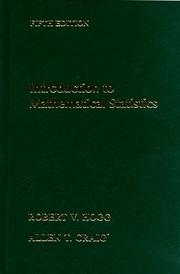 Introduction to mathematical statisticsRobert V. HoggA rigorous, uncompromising journey into the mathematical bedrock of probability and statistical inference.
 Introduction to linear algebraGilbert StrangAn illuminating, conversational guide that transforms abstract mathematical concepts into intuitive, geometric realities.
 Psychometric theoryJum C. NunnallyA comprehensive, authoritative dive into the mechanics of measurement and statistical inference.
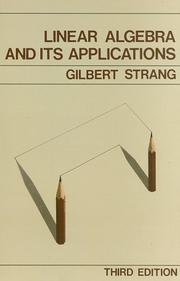 Linear algebra and its applicationsGilbert StrangA conversational, illuminating journey into the structural beauty of mathematics that makes abstract concepts feel tangible and intuitive.