Books › Introduction to linear algebra

Introduction to linear algebra
First published 1998 · 600 pages
An illuminating, conversational guide that transforms abstract mathematical concepts into intuitive, geometric realities.
What it feels like
Reading this book feels like sitting in the office of a brilliant, endlessly patient professor who genuinely wants you to see the beauty of mathematics. The pace is steady and deliberate, demanding your active participation, but the reward is a profound sense of clarity. Instead of drowning you in dry formalism, the narrative voice is remarkably conversational, guiding you toward intuitive, geometric aha moments where abstract numbers suddenly snap into tangible spaces. The mood is deeply focused yet encouraging, creating an intellectual atmosphere where confusion gradually gives way to structural understanding. It is a delight for self-learners, engineers, and anyone who craves the deep satisfaction of finally grasping the elegant mechanics that underpin modern computation and physics.
- Mood
- illuminating
- focused
- intellectual
- structured
- Tone
- conversational
- encouraging
- authoritative
- enthusiastic
- Pace
- steady
- Themes
- mathematical intuition · the beauty of structure · practical application · problem-solving
- The writing
- Remarkably conversational and direct, prioritizing intuitive understanding and geometric visualization over dry, formal proofs.
- The arc
- Moves from the initial friction of grappling with new notation to the profound satisfaction of seeing the hidden geometric structures of the world.
- Who it's for
- Curious students, engineers, and self-taught programmers who want to truly understand the mechanics of matrices rather than just memorizing algorithms.
About the book
Book Description: Gilbert Strang's textbooks have changed the entire approach to learning linear algebra -- away from abstract vector spaces to specific examples of the four fundamental subspaces: the column space and nullspace of A and A'. Introduction to Linear Algebra, Fourth Edition includes challenge problems to complement the review problems that have been highly praised in previous editions. The basic course is followed by seven applications: differential equations, engineering, graph theory, statistics, Fourier methods and the FFT, linear programming, and computer graphics. Thousands of teachers in colleges and universities and now high schools are using this book, which truly explains this crucial subject.
Description from Open Library.
Books like Introduction to linear algebra
See why they match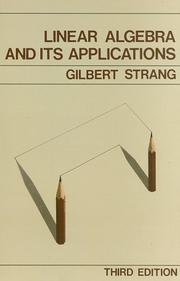 Linear algebra and its applicationsGilbert StrangA conversational, illuminating journey into the structural beauty of mathematics that makes abstract concepts feel tangible and intuitive.
 Elementary linear algebraHoward AntonA methodical and deeply pragmatic guide that transforms abstract mathematical concepts into accessible, structural tools.
 Linear algebra and its applicationsDavid C. Lay, Steven R. Lay and othersA methodical and illuminating journey through the foundational structures of mathematics that makes abstract concepts suddenly click into place.
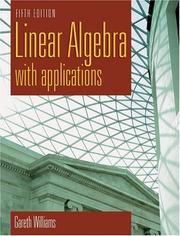 Linear Algebra with ApplicationsGareth WilliamsA rigorous, grounding exploration of mathematical structures that turns abstract theory into a powerful toolkit for real-world problem-solving.
 A first course in linear model theoryNalini RavishankerA rigorous, structured immersion into the mathematical foundations of statistical theory.
 Algebra & trigonometryMichael Sullivan IIIA methodical, visually driven exploration of mathematical foundations that transforms abstract numbers into tangible, solvable puzzles.