Books › Elementary differential equations

Elementary differential equations
First published 1952 · 546 pages
A rigorous, deeply satisfying journey through the mechanics of mathematical modeling and problem-solving.
What it feels like
Reading this text feels like sitting in a quiet, sunlit library with a sharp pencil and a fresh pad of paper, ready to untangle the hidden rules of the physical world. It is a deeply methodical experience, demanding a steady pace and focused attention as it builds from foundational concepts to complex applications. The atmosphere is one of rigorous clarity, devoid of unnecessary fluff, where the beauty lies in the logical progression of each proof and the satisfying click of a solved equation. It rewards the patient, analytical mind, offering a sense of hard-won mastery. Readers who find comfort in structure, precise language, and the elegant translation of physical phenomena into mathematical language will find this a deeply grounding and rewarding study.
- Mood
- focused
- analytical
- structured
- Tone
- academic
- clear
- methodical
- instructive
- Pace
- steady
- Themes
- problem solving · mathematical modeling · logical progression · applied mathematics
- The writing
- Crisp, precise, and highly structured, prioritizing clarity and step-by-step logical flow over stylistic flourish.
- The arc
- The reader moves from the daunting complexity of physical problems to the quiet satisfaction of finding elegant, structured solutions.
- Who it's for
- Analytical minds and STEM students who appreciate a no-nonsense, example-heavy approach to mastering complex equations.
About the book
A clear, concise book that emphasizes finding solutions to differential equations where applications play an important role. Each chapter includes many illustrative examples to assist the reader. The book emphasizes methods for finding solutions to differential equations. It provides many abundant exercises, applications, and solved examples with careful attention given to readability. Elementary Differential Equations includes a thorough treatment of power series techniques. In addition, the book presents a classical treatment of several physical problems to show how Fourier series become involved in the solution of those problems. The eighth edition of Elementary Differential Equations has been revised to include a new supplement in many chapters that provides suggestions and exercises for using a computer to assist in the understanding of the material in the chapter. It also now provides an introduction to the phase plane and to different types of phase portraits. A valuable reference book for readers interested in exploring the technological and other applications of differential equations.
Description from Open Library.
Books like Elementary differential equations
See why they match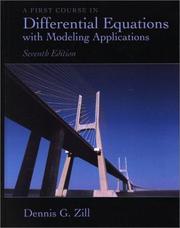 A first course in differential equations with modeling applicationsDennis G. ZillA rigorous, structured journey through the mathematics of change, offering the deep satisfaction of solving complex physical models.
 Advanced engineering mathematicsC. Ray WylieA deeply rigorous, proof-oriented exploration of mathematics that demands patience and rewards analytical thought.
 Differential and integral calculusClyde E. LoveA quiet, rigorous journey through the foundational mechanics of mathematics, rewarding patient study with profound clarity.
 Lehninger Principles of BiochemistryDavid L. NelsonA rigorous, illuminating journey into the elegant molecular machinery that powers life itself.
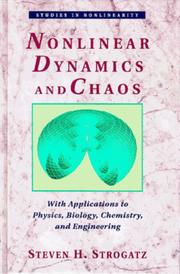 Nonlinear dynamics and ChaosSteven StrogatzAn enthusiastic, deeply intuitive journey into the mathematical heartbeat of the universe, revealing the hidden order inside apparent randomness.
 Elementary principles of chemical processesRichard M. FelderA clear, methodical dive into the practical realities of chemical engineering.