Books › Elementary linear algebra

Elementary linear algebra
872 pages
A methodical and deeply pragmatic guide that transforms abstract mathematical concepts into accessible, structural tools.
What it feels like
Reading this book feels like being guided through a complex architectural blueprint by a patient, exacting mentor. The pace is inherently steady, demanding focus as you navigate the transition from concrete computations to abstract theoretical spaces. It is an intellectual and methodical experience, where the initial friction of grappling with dense proofs gradually gives way to deeply satisfying moments of clarity. The prose is stripped of flourish, prioritizing precision and logical flow, while thoughtful marginal notes act as a safety net during particularly steep conceptual climbs. It is a deeply pragmatic space, grounded in real-world engineering applications that constantly remind you why these abstract structures matter. This is a foundational text that rewards patient, deliberate study with a profound sense of mathematical mastery.
- Mood
- focused
- structured
- intellectual
- methodical
- Tone
- authoritative
- instructive
- analytical
- pragmatic
- Pace
- steady
- Themes
- mathematical reasoning · problem solving · abstract thinking · practical application
- The writing
- Precise, methodical, and highly structured, utilizing marginal notes and clear examples to demystify complex logical steps.
- The arc
- Moves from the daunting abstraction of new concepts to the satisfying click of logical comprehension and practical mastery.
- Who it's for
- Undergraduates and engineering students who need a reliable, accessible guide to bridge the gap between computation and abstract mathematical theory.
About the book
Abstract: When it comes to learning linear algebra, engineers trust Anton. The tenth edition presents the key concepts and topics along with engaging and contemporary applications. The chapters have been reorganized to bring up some of the more abstract topics and make the material more accessible. More theoretical exercises at all levels of difficulty are integrated throughout the pages, including true/false questions that address conceptual ideas. New marginal notes provide a fuller explanation when new methods and complex logical steps are included in proofs. Small-scale applications also show how concepts are applied to help engineers develop their mathematical reasoning.
Description from Open Library.
Books like Elementary linear algebra
See why they match Introduction to linear algebraGilbert StrangAn illuminating, conversational guide that transforms abstract mathematical concepts into intuitive, geometric realities.
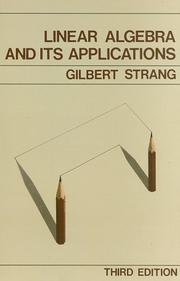 Linear algebra and its applicationsGilbert StrangA conversational, illuminating journey into the structural beauty of mathematics that makes abstract concepts feel tangible and intuitive.
 Calculus with analytic geometryHoward AntonA rigorous but deeply supportive journey through the foundational mechanics of mathematics and the physical world.
 Linear algebra and its applicationsDavid C. Lay, Steven R. Lay and othersA methodical and illuminating journey through the foundational structures of mathematics that makes abstract concepts suddenly click into place.
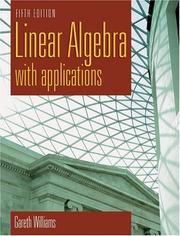 Linear Algebra with ApplicationsGareth WilliamsA rigorous, grounding exploration of mathematical structures that turns abstract theory into a powerful toolkit for real-world problem-solving.
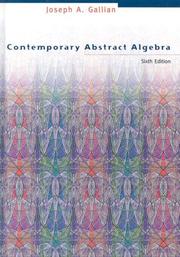 Contemporary Abstract AlgebraJoseph GallianA welcoming, structured journey into the hidden symmetries and logical architectures that underpin modern mathematics.