Books › Hope in the Dark
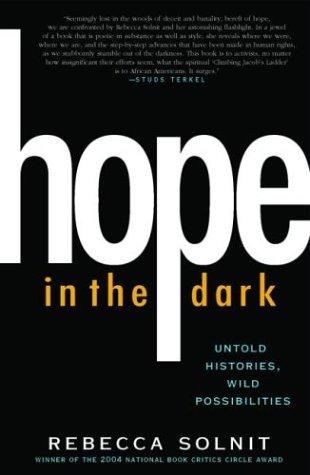
Hope in the Dark
Untold Histories, Wild Possibilities
First published 2004 · 240 pages
A luminous, intellectual lifeline for the politically exhausted, reframing uncertainty as the very soil where change takes root.
What it feels like
Reading this book feels like stepping out of a suffocating, windowless room and taking a deep breath of crisp night air. It is a steady, contemplative experience that doesn't offer toxic positivity, but rather a rigorous, historically grounded argument for why giving up is intellectually lazy. The prose is lyrical and incisive, weaving together forgotten activist victories and philosophical musings to create a luminous atmosphere of possibility. It sits with you, demanding reflection while quietly galvanizing your spirit. Perfect for organizers, artists, and anyone feeling crushed by the weight of the news cycle, this is a defiant, compassionate companion that transforms political despair into a fierce, actionable commitment to the unknown.
- Mood
- galvanizing
- contemplative
- luminous
- grounded
- Tone
- earnest
- urgent
- compassionate
- defiant
- intellectual
- Pace
- steady
- Themes
- radical optimism · the power of uncertainty · collective action · historical amnesia · activist burnout
- The writing
- Lyrical, incisive, and deeply essayistic, weaving historical anecdotes with philosophical reflection.
- The arc
- Moves from acknowledging deep political despair to cultivating a resilient, action-oriented sense of possibility.
- Who it's for
- Politically engaged readers and activists seeking an intellectual and emotional antidote to burnout and cynicism.
Content notes
- political despair
- systemic injustice
- climate anxiety
About the book
A book as powerful and influential as Rebecca Solnit's Men Explain Things to Me, her Hope in the Dark was written to counter the despair of radicals at a moment when they were focused on their losses and had turned their back to the victories behind them—and the unimaginable changes soon to come. In it, she makes a radical case for hope as a commitment to act in a world whose future remains uncertain and unknowable. Drawing on her decades of activism and a wide reading of environmental, cultural, and political history, Solnit argued that radicals have a long, neglected history of transformative victories, that the positive consequences of our acts are not always immediately seen, directly knowable, or even measurable, and that pessimism and despair rest on an unwarranted confidence about what is going to happen next.
Now, with a moving new introduction explaining how the book came about and a new afterword that helps teach us how to hope and act in our unnerving world, she brings a new illumination to the darkness of 2016 in an unforgettable new edition of this classic book.
Description from Open Library.
Books like Hope in the Dark
See why they match Mutual AidDean SpadeA clear-eyed, galvanizing handbook for surviving systemic collapse through radical, everyday solidarity.
 Men Explain Things To MeRebecca SolnitA sharp, validating intellectual toolkit that transforms everyday frustrations into a profound critique of systemic silencing.
 A paradise built in hellRebecca SolnitA surprisingly uplifting exploration of how our darkest moments reveal the profound human capacity for radical solidarity.
 This Changes EverythingNaomi KleinA fiercely urgent wake-up call that transforms climate dread into a demand for radical systemic change.
 DrawdownPaul HawkenA pragmatic and deeply hopeful blueprint that cures climate despair with actionable, data-driven solutions.
 Pleasure Activismadrienne maree brownA radical, joyful invitation to center healing, desire, and happiness in the fight for a better world.