Books › Hyperspace

Hyperspace
A Scientific Odyssey Through Parallel Universes, Time Warps, and the 10th Dimension
First published 1994 · 359 pages
A mind-bending tour through the hidden dimensions of reality that makes the impossible feel mathematically inevitable.
What it feels like
Reading this book feels like having your brain gently but persistently stretched in directions you did not know existed. It is a dizzying, exhilarating ride through the unseen architecture of the cosmos, guided by a narrator whose sheer enthusiasm for the subject is infectious. Instead of drowning you in equations, the text relies on elegant, vivid analogies to make the incomprehensible suddenly click into place. The mood is one of profound, expansive wonder, transforming abstract theoretical physics into a thrilling intellectual adventure. It is perfect for anyone who has ever looked up at the night sky and wondered what invisible forces are holding the grand, bizarre puzzle of reality together.
- Mood
- mind-expanding
- cerebral
- wondrous
- expansive
- Tone
- enthusiastic
- accessible
- earnest
- awe-inspiring
- Pace
- brisk
- Themes
- the nature of reality · limits of human perception · the elegance of the cosmos · scientific revolution
- The writing
- Lucid and energetic, relying on vivid, everyday analogies to translate dense mathematical physics into digestible concepts.
- The arc
- Begins with grounded curiosity and accelerates into a profound, dizzying awe at the hidden architecture of the universe.
- Who it's for
- Armchair physicists and curious dreamers who want to peer behind the curtain of reality without getting bogged down in equations.
About the book
Are there other dimensions beyond our own? Is time travel possible? Can we change the past? Are there gateways to parallel universes? All of us have pondered such questions, but there was a time when scientists dismissed these notions as outlandish speculations. Not any more. Today, they are the focus of the most intense scientific activity in recent memory.
In Hyperspace, Michio Kaku, author of the widely acclaimed Beyond Einstein and a leading theoretical physicist, offers the first book-length tour of the most exciting (and perhaps most bizarre) work in modern physics, work which includes research on the tenth dimension, time warps, black holes, and multiple universes.
The theory of hyperspace (or higher dimensional space) - and its newest wrinkle, superstring theory - stand at the center of this revolution, with adherents in every major research laboratory in the world, including several Nobel laureates. Beginning where Hawking's Brief History of Time left off, Kaku paints a vivid portrayal of the breakthroughs now rocking the physics establishment. Why all the excitement?
As the author points out, for over half a century, scientists have puzzled over why the basic forces of the cosmos - gravity, electromagnetism, and the strong and weak nuclear forces - require markedly different mathematical descriptions. But if we see these forces as vibrations in a higher dimensional space, their field equations suddenly fit together like pieces in a jigsaw puzzle, perfectly snug, in an elegant, astonishingly simple form. This may thus be our leading candidate for the Theory of Everything. If so, it would be the crowning achievement of 2,000 years of scientific investigation into matter and its forces.
Already, the theory has inspired several thousand research papers, and has been the focus of over 200 international conferences. Many leading scientists believe the theory will unlock the deepest secrets of creation and answer some of the most intriguing questions of all time, such as what happened before the Big Bang, whether the past can be altered, and if gateways to other universes exist
Description from Open Library.
Books like Hyperspace
See why they match Parallel WorldsMichio KakuA dizzying, exhilarating tour through the most mind-bending possibilities of modern physics.
 Beyond EinsteinMichio Kaku and Jennifer Trainer ThompsonAn exhilarating, mind-expanding leap into the elegant, hidden dimensions that weave our universe together.
 The Elegant UniverseBrian GreeneA mind-expanding journey into the hidden dimensions and fundamental fabric of reality that leaves you staring in awe at the everyday world.
 Three Roads to Quantum GravityLee SmolinAn awe-inspiring and deeply human journey to the very edge of our understanding of space, time, and reality.
 A Brief History of TimeStephen HawkingA mind-expanding journey to the very edges of space, time, and human understanding.
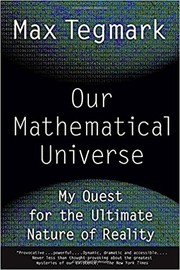 Our Mathematical UniverseMax TegmarkA dizzying, enthusiastic plunge into the radical idea that the cosmos isn't just described by math, but is made of it.