Books › Introduction to the theory of computation

Introduction to the theory of computation
First published 1996 · 396 pages
A masterclass in making profound, abstract mathematical concepts feel intuitive and beautifully elegant.
What it feels like
Reading this feels less like slogging through a dense academic textbook and more like sitting down with a brilliant, patient mentor who wants you to see the underlying beauty of computer science. The pace is steady and deliberate, asking you to pause and wrestle with abstract concepts, but it rewards that effort with sudden, illuminating flashes of insight. Instead of burying the reader in dry, low-level mathematical notation, the prose focuses on the 'why'—the intuitive proof ideas that make complex theorems suddenly click into place. The atmosphere is deeply intellectual yet surprisingly welcoming, building a structured, elegant world of automata and Turing machines. It is a deeply satisfying journey for anyone who wants to understand the absolute, fundamental limits of what a machine can actually do.
- Mood
- intellectual
- illuminating
- focused
- Tone
- clear
- encouraging
- rigorous
- elegant
- Pace
- steady
- Themes
- the limits of computation · mathematical elegance · abstract reasoning · problem-solving intuition
- The writing
- Exceptionally lucid and conversational, famously prioritizing intuitive 'proof ideas' before diving into formal mathematical rigor.
- The arc
- Transitions from the daunting complexity of abstract machines to the profound, satisfying clarity of understanding what is fundamentally computable.
- Who it's for
- Computer science students and curious programmers who want to grasp the deep, theoretical foundations of their craft without drowning in pedantic notation.
About the book
Michael Sipser's emphasis on unifying computer science theory - rather than offering a collection of low-level details - sets the book apart, as do his intuitive explanations. Throughout the book, Sipser builds students' knowledge of conceptual tools used in computer science, the aesthetic sense they need to create elegant systems, and the ability to think through problems on their own.
Description from Open Library.
Books like Introduction to the theory of computation
See why they match Switching and finite automata theoryZvi Kohavi; Niraj K. JhaA rigorous, methodical journey into the foundational logic that powers modern computing machinery.
 Quantum Computing Since DemocritusScott AaronsonAn informal, mind-expanding tour through the deepest philosophical and scientific questions of computation and reality.
 Concrete mathematicsRonald L. Graham and Oren PatashnikA rigorous, playful journey through the mathematical foundations of computer science that rewards deep focus with flashes of pure intellectual clarity.
 Compilers, principles, techniques, and toolsAlfred V. Aho, Ravi Sethi and othersA rigorous, foundational descent into the deep magic of how human-readable code is transformed into machine execution.
 Computer scienceJ. Glenn BrookshearA structured, illuminating map of the digital world that transforms technological mystery into foundational understanding.
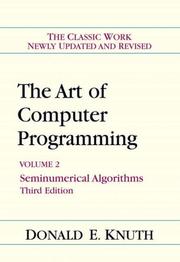 The art of computer programmingDonald KnuthA monumental, intellectually demanding pilgrimage into the mathematical soul of computation.