Books › Physics
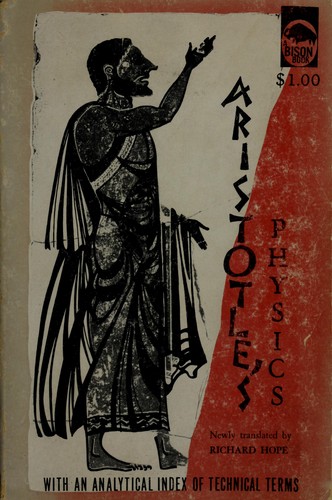
Physics
First published 1472 · 12750 pages
A rigorous, foundational descent into the mechanics of reality, change, and existence itself.
What it feels like
Reading this foundational text is like watching the architecture of Western scientific thought being built brick by brick. The experience is deeply cerebral and methodical, requiring a slow, deliberate pace as you navigate dense, syllogistic arguments about the nature of motion, time, and the infinite. It possesses an austere, contemplative mood, stripping away the mystical to examine the physical world through pure, unadulterated logic. The prose is rigorous and uncompromising, demanding your full intellectual engagement. It is not a book you breeze through; rather, it is an intellectual landscape you must carefully excavate. This work will profoundly delight philosophy enthusiasts, historians of science, and any reader who finds beauty in the relentless, structured pursuit of understanding how the universe fundamentally operates.
- Mood
- contemplative
- cerebral
- austere
- Tone
- analytical
- authoritative
- methodical
- objective
- Pace
- steady
- Themes
- the nature of change · causality and motion · the concept of infinity · time and space · foundations of reality
- The writing
- Dense, highly structured, and rigorously analytical, reading like the foundational blueprint of logical inquiry.
- The arc
- Moves from a state of profound questioning about the physical world to a structured, logical comprehension of motion and causality.
- Who it's for
- Deep thinkers, philosophy students, and historians of science who enjoy wrestling with the bedrock texts of Western thought.
About the book
Signatures: a-o8 p16 q-t8; u-z [et] [com] [rum] aa-gg8 hh6; ii-rr8; ss-tt8 vv10 xx-yy8.
Title from leaf 1 a.
BM calls this Opera nonnulla, with commentaries of Averroes.
This book was reissued as a continuation of Averroës, Destructiones destructionum in 1497.--Cf. Hain 2190.
Register does not include the Destructiones--Cf. leaf [392] a.
Decorative initial letters.
Woodcut capitals and diagrams.
Includes several colophons. 1st: Aristotelis stagarite philosopho[rum] monarche: //phisicorum opus: cum Auerroys Cordubensis // expositionibus feliciter explicit. Studio quoq[ue]: ac // Impensa Octauiani Scoti [?] diligentissime [et] ca//stigatissime correctu[m]: [et] ex stercore [et] tenebris: in no//bilissimum [et] clarissimum locum deductum: Ve-//netijs i[m]pressum a[n]no salutis d[omin]i. M.cccc.xcv. die // vltimo septembris.--Cf. leaf 160 b.
The second colophon (for De celo [et] mundo) is dated 28 November, 1495--Cf. leaf 262 a; and the third colophon (for De generatione et corruptione) is dated 5 December, 1495--Cf. leaf 278 b.
Final colophon: Summi philosophi Aristotelis Stagyrite // peripatheticorum principis: cum Auerroys cor-//dubensis expositionibus Metheororu[m] opus: cu[m] // noua traductione in quartum [et] vltimum predicti // voluminis feliciter explict. Impensa quoq[ue] ac di // ligentia Octauiani Scoti Venetijs impressum // fuit. Anno d[omin]i. M.cccc.lxxxxvj. die. xxij. Aprilis /// Laus Deo.--Cf. leaf [391] a (misnumbered 361).
BM 15th cent. V. 348 (IB.21097)
WSU MASC copy has a few notes penned in the margins by a previous owner.
Description from Open Library.
Books like Physics
See why they match Philosophiae naturalis principia mathematicaSir Isaac NewtonAn austere, monumental descent into the mathematical bedrock of the universe, revealing the hidden clockwork of reality.
 Discouerie of witchcraftReginald ScotAn atmospheric, antiquarian journey into early modern occultism, steeped in the history of magic and the tactile reality of a centuries-old text.
 Dell'Arte della GuerraNiccolò MachiavelliA rigorous, intellectual exploration of Renaissance realpolitik and the cold mechanics of military strategy.
 On the sublimeLonginusAn antiquarian deep-dive into the ancient mechanics of awe-inspiring language and literary majesty.
 De Occulta PhilosophiaHeinrich Cornelius Agrippa von NettesheimA fragmented, atmospheric descent into Renaissance magic and esoteric philosophy, pieced together from centuries-old manuscripts and cryptic symbols.
 Enarrationes in PsalmosAugustine of HippoA sweeping, deeply pastoral journey through human emotion and divine grace, anchored in ancient spiritual song.