Books › Quando deixamos de entender o mundo

Quando deixamos de entender o mundo
192 pages
A feverish, mind-bending descent into the terrifying intersection of absolute genius and total madness.
What it feels like
Reading this book feels like stumbling upon the manic, brilliant journals of a doomed philosopher. It begins with the comforting anchor of historical fact before slowly, imperceptibly slipping into a hallucinatory fever dream. The narrative moves at a propulsive, almost breathless pace, dragging you through the minds of history's greatest scientific geniuses as they brush up against the terrifying limits of human comprehension. There is a profound sense of vertigo that builds with each chapter—a dread-soaked realization that the pursuit of absolute truth often paves the way to unimaginable destruction. It is an unsettling, awe-inspiring experience, perfect for readers who want their intellect challenged and their grip on reality slightly loosened by hypnotic, boundary-defying prose.
- Mood
- unsettling
- feverish
- dread-soaked
- mind-bending
- claustrophobic
- Tone
- urgent
- obsessive
- philosophical
- hallucinatory
- clinical
- Pace
- propulsive
- Themes
- the cost of genius · limits of human comprehension · madness and discovery · destructive power of knowledge · blurring of fact and fiction
- The writing
- Hypnotic, dense, and relentlessly paced, seamlessly weaving historical record with terrifying imaginative leaps.
- The arc
- Begins with intellectual curiosity and accelerates into a spiraling, vertigo-inducing sense of existential dread.
- Who it's for
- Readers who crave intellectual thrillers and philosophical fiction that pushes the boundaries of reality and sanity.
Content notes
- mental illness and psychosis
- suicide
- mass death and war
- animal cruelty (historical experiments)
- existential dread
About the book
A fictional examination of the lives of real-life scientists and thinkers whose discoveries resulted in moral consequences beyond their imagining.
When We Cease to Understand the World is a book about the complicated links between scientific and mathematical discovery, madness, and destruction.
Fritz Haber, Alexander Grothendieck, Werner Heisenberg, Erwin Schrödinger—these are some of luminaries into whose troubled lives Benjamín Labatut thrusts the reader, showing us how they grappled with the most profound questions of existence. They have strokes of unparalleled genius, alienate friends and lovers, descend into isolation and insanity. Some of their discoveries reshape human life for the better; others pave the way to chaos and unimaginable suffering. The lines are never clear.
At a breakneck pace and with a wealth of disturbing detail, Labatut uses the imaginative resources of fiction to tell the stories of the scientists and mathematicians who expanded our notions of the possible.
Description from Open Library.
Books like Quando deixamos de entender o mundo
See why they match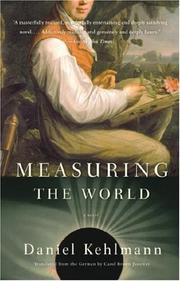 Die Vermessung der WeltDaniel KehlmannA wry, sparkling exploration of two eccentric geniuses trying to capture the infinite universe within the limits of their deeply flawed human lives.
 The half-life of factsSamuel ArbesmanA reassuring and fascinating exploration of why what we know is always changing, and how to find comfort in the predictable rhythms of discovery.
 LeviathanPaul AusterA hypnotic, existential mystery that unravels the fragile threads of identity, friendship, and the unpredictable forces of chance.
 In the Country of Last ThingsPaul AusterA haunting, epistolary descent into a crumbling metropolis where memory and meaning must be scavenged from the ruins.
 Song for the Unraveling of the WorldBrian EvensonA masterclass in the uncanny that quietly and methodically dismantles your grip on reality.
 Losing EarthNathaniel RichA gripping, infuriating historical thriller about the decade we almost saved the world, and the human flaws that stopped us.