Books › The 80/20 principle
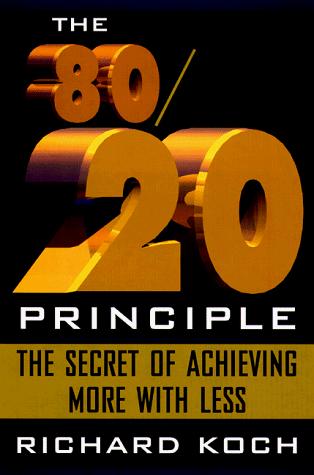
The 80/20 principle
the secret of achieving more with less
First published 1997 · 302 pages
A clarifying lens that cuts through the noise of daily overwhelm to reveal the hidden levers of true effectiveness.
What it feels like
Reading this book feels like putting on a pair of noise-canceling headphones in a chaotic room. It offers a brisk, intellectually stimulating journey that systematically dismantles the glorification of busyness. The prose is pragmatic and persuasive, grounding its central thesis in accessible examples that make you rethink your daily habits. There is a distinct mood of liberation that builds chapter by chapter as you realize how much of your effort is genuinely wasted. It shifts your emotional state from overwhelmed to empowered, providing a clarifying lens for both career and personal life. This is a must-read for exhausted professionals, ambitious creatives, and anyone desperate to stop spinning their wheels and start focusing on the few things that actually move the needle.
- Mood
- clarifying
- focused
- empowering
- Tone
- pragmatic
- analytical
- encouraging
- authoritative
- Pace
- brisk
- Themes
- strategic essentialism · maximizing leverage · letting go of the trivial · working smarter
- The writing
- Clear, accessible, and persuasive, relying on practical examples rather than dense academic jargon.
- The arc
- Moves from the heavy burden of endless busyness to a liberated sense of focused empowerment.
- Who it's for
- Overworked professionals and ambitious individuals looking to reclaim their time by cutting out the noise.
About the book
"The 80/20 Principle shows how you can achieve much more with much less effort, time, and resources, simply by concentrating on the all-important 20 percent.".
"The pattern of predictable imbalance underlying the 80/20 Principle was first discovered a hundred years ago by Italian economist Vilfredo Pareto while studying income and wealth patterns. But the pattern of "predictable imbalance," as he termed it, crops up throughout life. In The 80/20 Principle, Koch opens our eyes to the way the principle works through a wide range of examples in business, commerce, and virtually every aspect of our lives.
For example, 20 percent of products account for 80 percent of sales and profits; similarly, 20 percent of customers account for 80 percent of revenues.".
"By identifying and focusing on the 20 percent of our efforts that result in the huge bulk of our success, we can leverage our efforts to vastly increase our effectiveness. For we discover that little of what we do really counts. By concentrating on those things that do, we can transform our effectiveness in our jobs, our careers, our businesses, and our lives."--BOOK JACKET.
Description from Open Library.
Books like The 80/20 principle
See why they match The power of lessLeo BabautaA deep, cleansing breath for the chronically overwhelmed mind, offering a gentle path out of the modern productivity trap.
 Deep WorkCal NewportA rigorous, clarifying manifesto for reclaiming your attention and finding quiet mastery in a world of constant digital noise.
 Principle-Centered LeadershipStephen R. CoveyA grounded, inside-out guide to finding balance and unleashing potential in a high-pressure world.
 The happiness advantageShawn AchorA refreshing, science-backed permission slip to put your own joy before your ambition.
 Lean thinkingJames P. WomackA pragmatic, clarifying blueprint for stripping away the unnecessary and building systems that actually work.
 The First 20 HoursJosh KaufmanA pragmatic, energizing toolkit that transforms the daunting mountain of a new hobby into a series of highly climbable steps.