Books › The Anxious Generation
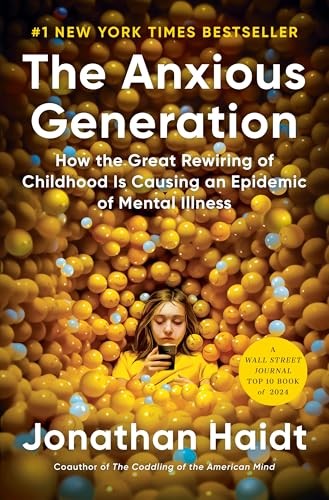
The Anxious Generation
456 pages
A sobering but ultimately empowering investigation into how screens rewired childhood and how society can reclaim it.
What it feels like
Reading this feels like sitting down with a deeply concerned but highly organized expert who is finally explaining a cultural shift you have felt in your bones but could not quite articulate. The atmosphere is initially sobering, steeped in stark realities about adolescent mental health, yet it never tips into pure despair. Instead, the steady, accessible prose builds a structured, persuasive argument that transforms free-floating anxiety into clear-eyed understanding. As the narrative shifts from diagnosis to prescription, the mood lifts into something genuinely galvanizing. It is an essential, thought-provoking experience for parents, educators, and anyone seeking a practical, community-driven roadmap out of the digital woods and back to a grounded, play-based reality.
- Mood
- sobering
- alarming
- thought-provoking
- galvanizing
- Tone
- urgent
- analytical
- earnest
- authoritative
- prescriptive
- Pace
- steady
- Themes
- technological rewiring of society · loss of childhood independence · mental health crisis · collective action and community · the necessity of unstructured play
- The writing
- Clear, accessible, and highly structured, relying on persuasive analogies and robust data to build its case.
- The arc
- Begins with a sobering plunge into alarming statistics and shifts into a galvanizing, solution-oriented call to action.
- Who it's for
- Parents, educators, and culturally curious readers looking for a concrete explanation of and solutions to the modern youth mental health crisis.
Content notes
- depression
- anxiety
- self-harm
- suicide
About the book
After more than a decade of stability or improvement, the mental health of adolescents plunged in the early 2010s. Rates of depression, anxiety, self-harm, and suicide rose sharply, more than doubling on many measures. Why?
In The Anxious Generation, social psychologist Jonathan Haidt (pronounced "height") lays out the facts about the epidemic of teen mental illness that hit many countries at the same time. He then investigates the nature of childhood, including why children need play and independent exploration to mature into competent, thriving adults. Haidt shows how the “play-based childhood” began to decline in the 1980s, and how it was finally wiped out by the arrival of the “phone-based childhood” in the early 2010s. He presents more than a dozen mechanisms by which this “great rewiring of childhood” has interfered with children’s social and neurological development, covering everything from sleep deprivation to attention fragmentation, addiction, loneliness, social contagion, social comparison, and perfectionism. He explains why social media damages girls more than boys and why boys have been withdrawing from the real world into the virtual world, with disastrous consequences for themselves, their families, and their societies.
Most important, Haidt issues a clear call to action. He diagnoses the “collective action problems” that trap us, and then proposes four simple rules that might set us free. He describes steps that parents, teachers, schools, tech companies, and governments can take to end the epidemic of mental illness and restore a more humane childhood.
Haidt has spent his career speaking truth backed by data in the most difficult landscapes—communities polarized by politics and religion, campuses battling culture wars, and now the public health emergency faced by Gen Z. We cannot afford to ignore his findings about protecting our children—and ourselves—from the psychological damage of a phone-based life.
Description from Open Library.
Books like The Anxious Generation
See why they match The Coddling of the American MindGreg Lukianoff and Jonathan HaidtAn urgent, analytical deep-dive into the cultural shifts reshaping childhood, campus life, and American discourse.
 Lost connectionsJohann HariA deeply validating, journalistic journey that reframes our deepest psychological pains as a rational response to a disconnected world.
 My age of anxietyScott StosselA candid, deeply researched journey through the personal and historical landscapes of chronic anxiety.
 Unwinding AnxietyJudson BrewerA compassionate, science-backed roadmap out of the exhausting loops of worry and fear.
 Stolen FocusJohann HariA deeply validating investigation into why your brain feels broken, shifting the blame from your willpower to the world around you.
 Digital MinimalismCal NewportA clear-eyed, practical manifesto for reclaiming your attention and finding quiet in an increasingly noisy world.