Books › The world Jones made

The world Jones made
First published 1979 · 215 pages
A paranoid, fast-paced trip through a bizarre future where knowing exactly what happens next is the ultimate curse.
What it feels like
Reading this early Philip K. Dick novel feels like stepping into a fever dream of mid-century paranoia and philosophical pulp. The pace is brisk, hurtling you through a gritty, surreal dystopia where bizarre concepts—from government-mandated relativism to genetically engineered mutants—are thrown at the wall with dizzying speed. The mood is distinctly claustrophobic, steeped in the cynical realization that knowing the future doesn't mean you can change it. The prose is utilitarian, serving primarily as a rapid-fire delivery system for mind-bending ideas about free will, demagoguery, and the dangers of absolute certainty. It is a perfect fit for readers who crave classic, idea-driven science fiction that leaves them questioning the nature of reality and the illusion of choice long after the final page.
- Mood
- dystopian
- surreal
- claustrophobic
- gritty
- Tone
- cynical
- satirical
- paranoid
- philosophical
- Pace
- brisk
- Themes
- illusion of free will · danger of absolute certainty · political demagoguery · burden of foresight · societal conformity
- The writing
- Utilitarian and fast-paced, prioritizing the rapid-fire delivery of bizarre concepts over lyrical polish.
- The arc
- Moves from a state of bizarre, uneasy equilibrium into a spiraling sense of paranoid inevitability.
- Who it's for
- Readers who love classic, idea-driven sci-fi that wraps philosophical thought experiments in weird, paranoid pulp.
Content notes
- drug use
- political extremism
- nuclear fallout themes
- forced labor camps
About the book
The World Jones Made is a 1956 science fiction novel by American writer Philip K. Dick, examining notions of precognition, humanity, and politics. It was first published by Ace Books as one half of Ace Double D-150, bound dos-à-dos with Agent of the Unknown by Margaret St. Clair.
The World Jones Made is set in the year 2002 AD. On a then-future post-apocalyptic Earth, there was a devastating conflict that involved the use of atomic weapons. Many American cities were targeted, and the People's Republic of China (and Soviet Union) also collapsed, leading to the imposition of a Federal World Government (Fedgov).
In this particular dystopia, Relativism (a political theory having little to do with Einstein) emerged as the governing political orthodoxy. Relativism is said to be a moral and ethical philosophy that states everyone is free to believe what they wish, as long as they don't make anyone else try to follow that principle. Relativism has become established law after the destructiveness of the war unleashed by clashing ideologies. (However, dissidents from that orthodoxy do end up in forced labor camps). This sacrosanct principle is challenged by a man named Floyd Jones, whose assertions about the future prove correct.
Relativism enables legal consumption of drugs like heroin and marijuana, as well as watching live sex shows with hermaphrodite human mutants. Due to the mutagenic effects of radiation from wartime nuclear exchanges, mutants earn their living within the entertainment industry, although one group has been subjected to deliberate genetic engineering, which later enables them to settle (an inhabitable) Venus.
The novel addresses questions of Jones's agenda and trustworthiness as well as the decidedly ambiguous benefits of individual precognition.
Description from Open Library.
Books like The world Jones made
See why they match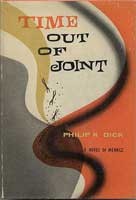 Time out of jointPhilip K. DickA creeping, existential puzzle box where the idyllic American dream slowly peels back to reveal a terrifying, manufactured void.
 A maze of deathPhilip K. DickA claustrophobic, paranoid descent into a reality that refuses to hold its shape, where the greatest threat is the human mind itself.
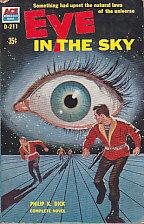 Eye in the skyDick Philip K.A surreal and satirical plunge into the terrifying, solipsistic universes born from our deepest prejudices and fears.
 Martian Time-SlipPhillip K. DickA dusty, paranoid descent into a fractured reality where time, sanity, and corporate greed collide on a desolate frontier.
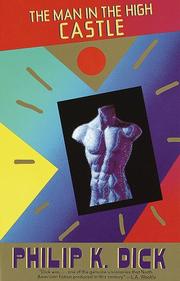 The Man in the High CastlePhilip DickA paranoid, mind-bending exploration of a fractured reality where history went wrong and truth is a dangerous illusion.
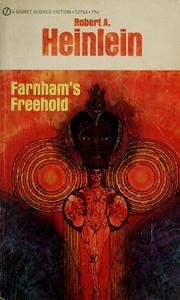 Farnham's FreeholdRobert Anson HeinleinA provocative, survivalist thought experiment that flips the social order to explore the darkest edges of human subjugation and self-reliance.