Books › A grammatical view of logic programming

A grammatical view of logic programming
First published 1993 · 490 pages
A rigorous, deeply cerebral exploration of the mathematical elegance underlying computational logic and formal grammars.
What it feels like
Reading this book feels like stepping into a quiet, chalk-dusted lecture hall where every theorem is meticulously proven and every concept is built on a foundation of absolute logic. The text demands a slow, deliberate pace, rewarding the patient reader with a profound appreciation for the structural elegance of logic programming. It is uncompromisingly academic, trading narrative momentum for absolute precision and formal rigor. The mood is deeply cerebral and focused, wrapping the reader in a world of attribute grammars, proof trees, and formal semantics. This is a text for the dedicated computer scientist or logician who finds genuine beauty in mathematical abstraction and structural clarity, offering a deeply satisfying intellectual journey for those willing to engage with its dense, rewarding architecture.
- Mood
- cerebral
- focused
- academic
- structured
- Tone
- scholarly
- rigorous
- analytical
- precise
- Pace
- steady
- Themes
- formal systems · computational logic · structural elegance · theoretical foundations
- The writing
- Dense, mathematical, and uncompromisingly academic, prioritizing absolute clarity and formal precision over accessibility.
- The arc
- Moves from foundational curiosity to a deeply satisfying mastery of formal logical frameworks.
- Who it's for
- Computer scientists, logicians, and programming language theorists who revel in formal semantics and attribute grammars.
About the book
Includes bibliographical references (p. [431]-443) and index.
Description from Open Library.
Books like A grammatical view of logic programming
See why they match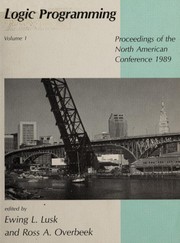 Logic programmingRoss A. OverbeekA rigorous, deeply cerebral exploration of the mathematical frameworks that underpin computational logic and programming.
 Representing and reasoning with probabilistic knowledgeFahiem BacchusA rigorous, deeply analytical dive into the mathematical foundations of how machines handle uncertainty.
 Beginning syntaxThomas, Linda.A methodical, satisfying puzzle-box approach to uncovering the hidden architecture of human language.
 C programmingKim N. KingA lucid, methodical journey into the bedrock of modern computing that transforms intimidation into structural mastery.
 Introduction to theoretical linguisticsLyons, JohnA rigorous, foundational journey into the structural mechanics and theoretical underpinnings of human language.
 An introduction to functional grammarMichael HallidayA rigorous, paradigm-shifting deep dive into the hidden architecture of how human beings make meaning through language.