Books › Cognitive Psychology

Cognitive Psychology
Connecting Mind, Research and Everyday Experience
First published 2004 · 608 pages
A structured, illuminating journey into the invisible machinery of human thought, memory, and perception.
What it feels like
Reading this feels like sitting in on a masterclass taught by a professor who genuinely wants you to understand the material, not just memorize it. The pace is steady and methodical, building complex neurological and psychological concepts from the ground up. It trades the dry, detached atmosphere of traditional textbooks for a mood of grounded curiosity, constantly tethering abstract theories and laboratory experiments back to the everyday experiences of remembering a name or perceiving a color. The prose is exceptionally clear and analytical, designed to foster critical thinking rather than passive absorption. It is deeply satisfying for the intellectually hungry reader who craves a structured, rigorous, yet highly accessible exploration of the human mind's inner workings.
- Mood
- intellectually stimulating
- structured
- curious
- illuminating
- Tone
- academic
- accessible
- analytical
- encouraging
- objective
- Pace
- steady
- Themes
- the mechanics of thought · everyday memory · critical evaluation of science · the brain-mind connection
- The writing
- Clear, methodical, and highly structured, prioritizing comprehension and real-world application over stylistic flourish.
- The arc
- Moves from foundational curiosity about how the mind works to a grounded, critical appreciation of human cognition in daily life.
- Who it's for
- Psychology students and deeply curious armchair scientists who want a rigorous but accessible breakdown of how human memory and perception actually function.
Content notes
- discussions of neurological disorders
- references to animal testing
About the book
There book is balance between classic and contemporary coverage of cognitive-behavioral and physiological approaches. There is in most all cases a very nice balance between experiment, theory, and everyday life. The author explains the weaknesses of any particular theory in a way that allows the student to understand not just how the particular theory is weak but also allows critical transfer to evaluation of other theories.
Description from Open Library.
Books like Cognitive Psychology
See why they match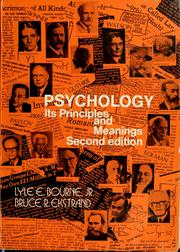 PsychologyLyle E. Bourne, Bruce R. Ekstrand and othersA methodical, retro-academic deep dive into the foundational theories of human behavior and the mind.
 Research methods in psychologyJohn ShaughnessyA rigorous, structured journey into the mechanics of how we scientifically study the human mind.
 Social Foundations of Thought and ActionAlbert BanduraA rigorous, paradigm-shifting exploration of how our minds, behaviors, and environments continuously shape one another.
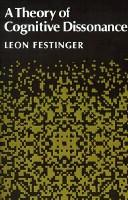 A Theory of Cognitive DissonanceLéon FestingerA foundational, paradigm-shifting exploration of the mental gymnastics we perform to keep our beliefs intact.
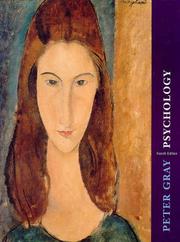 PsychologyGray, PeterAn illuminating, foundational journey into the biological and evolutionary 'whys' of human behavior.
 PsychologyDavid G. MyersAn illuminating, highly readable exploration of the human mind that transforms everyday observations into profound psychological insights.