Books › Day of Empire
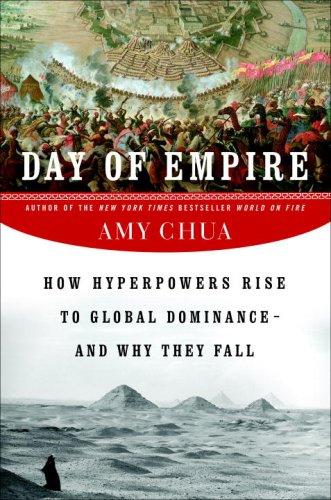
Day of Empire
How Hyperpowers Rise to Global Dominance--and Why They Fall
432 pages
A sweeping, macro-historical lens on the mechanics of global dominance and the surprising role of tolerance in building empires.
What it feels like
Reading this book feels like standing on a mountaintop, watching centuries of human history unfold in a grand, sweeping panorama. The narrative moves at a steady, deliberate pace, guiding the reader through the rise and fall of the world's most formidable empires with an analytical and authoritative tone. It creates an expansive, intellectual mood, inviting deep contemplation about the cyclical nature of power and the surprising historical patterns that connect ancient Rome to the modern United States. The prose is clear and structured, distilling vast epochs into focused, accessible arguments without losing the sheer scale of the subject. It is a deeply thought-provoking experience, perfect for readers who are fascinated by macro-history, political science, and grand theories of civilization.
- Mood
- intellectual
- expansive
- contemplative
- Tone
- analytical
- authoritative
- sweeping
- insightful
- Pace
- steady
- Themes
- the cyclical nature of power · the strategic value of tolerance · mechanics of global dominance · historical patterns of empire
- The writing
- Clear, structured, and expansive, distilling vast centuries of global history into focused, accessible arguments.
- The arc
- Moves from a sweeping awe at the ascendance of global empires to a contemplative reflection on the fragility of their dominance.
- Who it's for
- Readers who devour macro-history, political science, and grand, unifying theories about the rise and fall of civilizations.
Content notes
- imperialism
- historical conquest
- warfare
About the book
In a little over two centuries, America has grown from a regional power to a superpower, and to what is today called a hyperpower. But can America retain its position as the world's dominant power, or has it already begun to decline?Historians have debated the rise and fall of empires for centuries. To date, however, no one has studied the far rarer phenomenon of hyperpowers--those few societies that amassed such extraordinary military and economic might that they essentially dominated the world.Now, in this sweeping history of globally dominant empires, bestselling author Amy Chua explains how hyperpowers rise and why they fall. In a series of brilliantly focused chapters, Chua examines history's hyperpowers--Persia, Rome, Tang China, the Mongols, the Dutch, the British, and the United States--and reveals the reasons behind their success, as well as the roots of their ultimate demise.Chua's unprecedented study reveals a fascinating historical pattern. For all their differences, she argues, every one of these world-dominant powers was, at least by the standards of its time, extraordinarily pluralistic and tolerant. Each one succeeded by harnessing the skills and energies of individuals from very different backgrounds, and by attracting and exploiting highly talented groups that were excluded in other societies. Thus Rome allowed Africans, Spaniards, and Gauls alike to rise to the highest echelons of power, while the "barbarian" Mongols conquered their vast domains only because they practiced an ethnic and religious tolerance unheard of in their time. In contrast, Nazi Germany and imperial Japan, while wielding great power, failed to attain global dominance as a direct result of their racial and religious intolerance.But Chua also uncovers a great historical irony: in virtually every instance, multicultural tolerance eventually sowed the seeds of decline, and diversity became a liability, triggering conflict, hatred, and violence.The United States is the quintessential example of a power that rose to global dominance through tolerance and diversity. The secret to America's success has always been its unsurpassed ability to attract enterprising immigrants. Today, however, concerns about outsourcing and uncontrolled illegal immigration are producing a backlash against our tradition of cultural openness. Has America finally reached a "tipping point"? Have we gone too far in the direction of diversity and tolerance to maintain cohesion and unity? Will we be overtaken by rising powers like China, the EU or even India?Chua shows why American power may have already exceeded its limits and why it may be in our interest to retreat from our go-it-alone approach and promote a new multilateralism in both domestic and foreign affairs.
Description from Open Library.
Books like Day of Empire
See why they match The post-American worldFareed ZakariaA clear-eyed, panoramic view of a rapidly changing globe that replaces anxiety with pragmatic optimism.
 Why the West Rules - For NowIan MorrisA sweeping, God's-eye view of human history that turns millennia of data into a gripping puzzle about geography, power, and our collective future.
 The Next 100 YearsGeorge FriedmanA sweeping, provocative thought experiment that treats the future of global power as a grand, predictable chessboard.
 The hundred-year marathonMichael PillsburyA sobering, insider's look at global power dynamics that reads like a geopolitical thriller.
 EmpireNiall FergusonA sweeping, provocative journey through the mechanics of global power that challenges how we view the foundations of the modern world.
 War and Peace and WarPeter TurchinA sweeping, interdisciplinary exploration of the cyclical forces that build and destroy human empires.