Books › Global economic history

Global economic history
170 pages
A sweeping, efficient distillation of five centuries of global wealth, poverty, and the policies that divided the world.
What it feels like
Reading this book feels like stepping into a high-altitude observatory, watching five centuries of human industry and policy unfold in rapid, clear succession. As part of a 'Very Short Introduction' series, the pace is inherently brisk, distilling massive global shifts—from the Industrial Revolution to modern Big Push industrialization—into digestible, analytical insights. The mood is deeply intellectual and objective, stripping away the noise to focus on the mechanics of wealth, poverty, and technological change. The prose is clear and authoritative, designed to educate rather than embellish. It will delight curious minds who want a structured, macro-level understanding of why the modern economic world looks the way it does, offering a satisfying sense of clarity regarding the historical forces of globalization.
- Mood
- intellectual
- macro-focused
- contemplative
- Tone
- informative
- analytical
- objective
- authoritative
- Pace
- brisk
- Themes
- the origins of inequality · the mechanics of wealth and poverty · globalization and technological change · the impact of economic policy
- The writing
- Clear, concise, and academic, designed to distill complex global trends into accessible explanations.
- The arc
- Moves from a sense of historical curiosity to a structured, satisfying understanding of global disparities.
- Who it's for
- Readers seeking a rapid, high-level understanding of how historical policies and technologies shaped modern global wealth disparities.
Content notes
- discussions of poverty and global inequality
About the book
Why are some countries rich and others poor? In 1500, global income differences were small, but disparities have grown dramatically since Columbus reached America. In this Very Short Introduction, Robert C. Allen shows how the interplay of geography, globalization, technological change, and economic policy has determined the wealth and poverty of nations. Allen shows how the industrial revolution was Britain's path-breaking response to the challenge of globalization. Western Europe and North America joined Britain to form a club of rich nations, pursuing four policies--creating a national market by abolishing internal tariffs and investing in transportation, erecting an external tariff to protect their fledgling industries from British competition, creating banks to stabilize the currency and mobilize domestic savings for investment, and promoting mass education to prepare people for industrial work. Together these countries pioneered new technologies that have made them ever richer. A few countries--Japan, Soviet Russia, South Korea, Taiwan, and perhaps China--have caught up with the West through creative responses to the technological challenge and with Big Push industrialization that has achieved rapid growth through coordinated investment. -- Book Description.
Description from Open Library.
Books like Global economic history
See why they match The wealth and poverty of nationsDavid S. LandesA sweeping, opinionated masterclass in economic history that challenges the reader to grapple with the cultural and technological roots of global inequality.
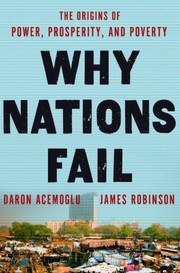 Why Nations FailDaron Acemoglu and James A. RobinsonA sweeping, intellectually rigorous journey through history that decodes the hidden machinery of global inequality.
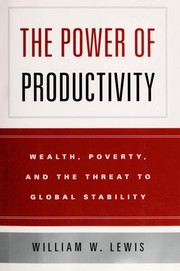 The Power of ProductivityWilliam W. LewisA clear-eyed, data-driven autopsy of global economic inequality and a pragmatic blueprint for structural change.
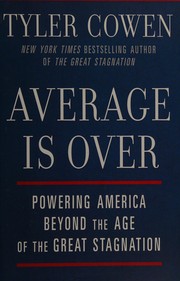 Average is OverTyler CowenA sobering but pragmatic look at the widening economic divide and how technology is permanently rewriting the rules of work.
 Good Economics for Hard TimesEsther DufloA compassionate, myth-busting journey through modern policy that replaces partisan panic with evidence-based hope.
 Basic economicsThomas SowellA masterclass in stripping away political rhetoric to reveal the hidden, often counterintuitive gears that drive human societies.