Books › Physics of the Impossible

Physics of the Impossible
A Scientific Exploration into the World of Phasers, Force Fields, Teleportation, and Time Travel
First published 2008 · 414 pages
A mind-expanding bridge between the wild imagination of science fiction and the rigorous frontiers of theoretical physics.
What it feels like
Reading this book feels like sitting down with a brilliant, endlessly enthusiastic professor who takes your wildest sci-fi daydreams seriously. The narrative moves at a brisk, engaging clip, leaping from force fields to time travel with an infectious optimism that makes theoretical physics feel entirely approachable. Instead of getting bogged down in dense equations, the prose relies on vivid, everyday analogies that spark a profound sense of wonder. It is an intellectually stimulating experience that sits right at the intersection of imagination and reality. Perfect for science fiction fans and curious minds alike, it leaves you looking up at the stars with a renewed, awe-struck belief in what humanity might one day achieve.
- Mood
- wonder-filled
- mind-expanding
- futuristic
- intellectually stimulating
- Tone
- enthusiastic
- accessible
- optimistic
- authoritative
- inquisitive
- Pace
- brisk
- Themes
- the limits of human knowledge · intersection of imagination and reality · technological optimism · the evolution of science
- The writing
- Clear, conversational, and highly accessible, relying on vivid analogies rather than dense mathematics to explain complex theories.
- The arc
- Begins with playful curiosity about beloved sci-fi tropes and expands into a profound sense of awe regarding the universe's true potential.
- Who it's for
- Sci-fi enthusiasts and curious minds who want to understand the actual physics behind their favorite futuristic concepts.
About the book
A fascinating exploration of the science of the impossible—from death rays and force fields to invisibility cloaks—revealing to what extent such technologies might be achievable decades or millennia into the future.
One hundred years ago, scientists would have said that lasers, televisions, and the atomic bomb were beyond the realm of physical possibility. In Physics of the Impossible, the renowned physicist Michio Kaku explores to what extent the technologies and devices of science fiction that are deemed equally impossible today might well become commonplace in the future.
From teleportation to telekinesis, Kaku uses the world of science fiction to explore the fundamentals—and the limits—of the laws of physics as we know them today. He ranks the impossible technologies by categories—Class I, II, and III, depending on when they might be achieved, within the next century, millennia, or perhaps never. In a compelling and thought-provoking narrative, he explains:
How the science of optics and electromagnetism may one day enable us to bend light around an object, like a stream flowing around a boulder, making the object invisible to observers “downstream” - How ramjet rockets, laser sails, antimatter engines, and nanorockets may one day take us to the nearby stars - How telepathy and psychokinesis, once considered pseudoscience, may one day be possible using advances in MRI, computers, superconductivity, and nanotechnology - Why a time machine is apparently consistent with the known laws of quantum physics, although it would take an unbelievably advanced civilization to actually build one
Kaku uses his discussion of each technology as a jumping-off point to explain the science behind it. An extraordinary scientific adventure, Physics of the Impossible takes readers on an unforgettable, mesmerizing journey into the world of science that both enlightens and entertains.
Description from Open Library.
Books like Physics of the Impossible
See why they match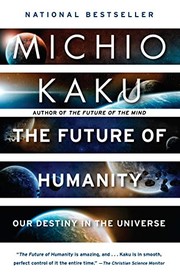 The future of humanityMichio KakuAn exhilarating, mind-expanding leap into the cosmos that makes the impossible feel like tomorrow's news.
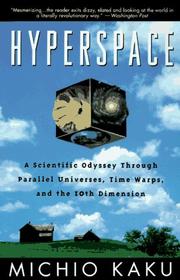 HyperspaceMichio KakuA mind-bending tour through the hidden dimensions of reality that makes the impossible feel mathematically inevitable.
 The Science of InterstellarKip ThorneA mind-expanding journey that bridges the gap between Hollywood spectacle and the awe-inspiring realities of theoretical physics.
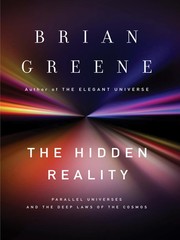 The Hidden RealityBrian GreeneA mind-expanding journey to the very edges of theoretical physics that will leave you questioning the fundamental nature of existence.
 The Beginning of InfinityDavid DeutschA mind-expanding philosophical journey that makes the universe feel fundamentally comprehensible and human potential utterly limitless.
 From eternity to hereSean CarrollA mind-bending journey from the scrambled eggs on your breakfast plate to the very origins of the universe.