Books › Sapiens
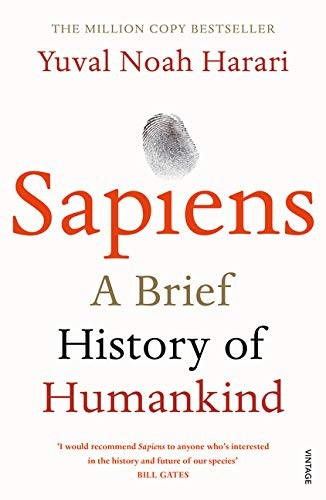
Sapiens
A Brief History of Humankind
636 pages
A sweeping, paradigm-shifting journey that reveals the everyday structures of human life as nothing more than powerful, shared fictions.
What it feels like
Reading this feels like stepping into a glass elevator that shoots up into the stratosphere, allowing you to look down at the entire timeline of human existence from a dizzying, god-like vantage point. The narrative moves at a brisk, confident clip, sweeping across millennia to dismantle everything you thought you knew about money, religion, and empire. It is an expansive, deeply existential reading experience that oscillates between awe at human ingenuity and a sobering dread regarding our destructive capabilities. The prose is sharp, accessible, and often wry, using vivid analogies to make complex evolutionary biology and anthropology feel like a gripping campfire story. It will delight curious, big-picture thinkers who love having their fundamental assumptions about the world completely rewired.
- Mood
- expansive
- awe-inspiring
- existential
- sobering
- Tone
- provocative
- authoritative
- wry
- philosophical
- detached
- Pace
- brisk
- Themes
- the power of shared myths · the cost of progress · human exceptionalism · ecological impact · the illusion of order
- The writing
- Lucid and conversational, relying on sharp analogies and bold declarations to distill millennia of complex history into digestible, paradigm-shifting insights.
- The arc
- Begins with a sense of wonder at our unlikely survival, transitioning into a sobering, existential reflection on the immense cost of our dominance.
- Who it's for
- Curious, big-picture thinkers who enjoy having their fundamental assumptions about society, religion, and human nature challenged.
Content notes
- animal cruelty
- ecological destruction
- mass extinction
- historical violence
About the book
From a renowned historian comes a groundbreaking narrative of humanity’s creation and evolution—a —that explores the ways in which biology and history have defined us and enhanced our understanding of what it means to be “human.”
One hundred thousand years ago, at least six different species of humans inhabited Earth. Yet today there is only one—homo sapiens. What happened to the others? And what may happen to us?
Most books about the history of humanity pursue either a historical or a biological approach, but Dr. Yuval Noah Harari breaks the mold with this highly original book that begins about 70,000 years ago with the appearance of modern cognition. From examining the role evolving humans have played in the global ecosystem to charting the rise of empires, Sapiens integrates history and science to reconsider accepted narratives, connect past developments with contemporary concerns, and examine specific events within the context of larger ideas.
Dr. Harari also compels us to look ahead, because over the last few decades humans have begun to bend laws of natural selection that have governed life for the past four billion years. We are acquiring the ability to design not only the world around us, but also ourselves. Where is this leading us, and what do we want to become?
Featuring 27 photographs, 6 maps, and 25 illustrations/diagrams, this provocative and insightful work is sure to spark debate and is essential reading for aficionados of Jared Diamond, James Gleick, Matt Ridley, Robert Wright, and Sharon Moalem.
Description from Open Library.
Books like Sapiens
See why they match 21 Lessons for the 21st CenturyYuval Noah HarariA clarifying, panoramic sweep of the modern world's most urgent anxieties, offering a steadying hand in an age of information overload.
 NexusYuval Noah HarariA sweeping, bird's-eye view of human history that leaves you both marveling at our ingenuity and deeply unsettled by our future.
 Big HistoryCynthia Stokes BrownA sweeping, interdisciplinary journey that shrinks the cosmos into an accessible mosaic of deep time and human ecology.
 The secret of our successJoseph Patrick HenrichA paradigm-shifting exploration that dismantles the myth of the lone genius to reveal the true superpower of our species: our collective brain.
 A Brief History of Everyone Who Ever LivedAdam RutherfordA witty, mind-expanding journey through our DNA that proves human history is far messier and more interconnected than we ever imagined.
 Human UniverseBrian Cox and Andrew CohenA sweeping, awe-inspiring journey that connects the vastness of the cosmos to the spark of human curiosity.