Books › Syntactic structures

Syntactic structures
First published 1957 · 197 pages
A rigorous, paradigm-shifting descent into the hidden mathematical architecture of human language.
What it feels like
Reading this foundational text feels like being handed the blueprints to human thought. It is a deeply cerebral and austere experience, demanding a steady, methodical pace as you navigate its dense thickets of symbolic logic and formal rules. The atmosphere is one of intense intellectual focus, stripping away the messy surface of everyday speech to reveal a pristine, mathematical architecture underneath. There is a distinct thrill in watching a paradigm shift unfold on the page, as the text systematically dismantles old assumptions and builds a revolutionary framework in their place. It will profoundly delight cognitive scientists, philosophers, and analytical readers who love the satisfaction of discovering the invisible, infinite systems that govern our most fundamental human trait.
- Mood
- cerebral
- austere
- intellectual
- focused
- Tone
- analytical
- rigorous
- objective
- academic
- authoritative
- Pace
- steady
- Themes
- the architecture of thought · rule-based systems · infinite potential from finite means · structural logic
- The writing
- Dense, formal, and highly technical, reading more like a treatise in symbolic logic than a traditional humanities text.
- The arc
- Moves from a methodical deconstruction of surface grammar to a profound, paradigm-shifting revelation of language's hidden mathematical architecture.
- Who it's for
- Linguistics students, cognitive scientists, and analytical thinkers who delight in uncovering the invisible rules that govern human behavior.
About the book
American linguist Paul Postal wrote in 1964 that most of the "syntactic conceptions prevalent in the United States" were "versions of the theory of phrase structure grammars in the sense of Chomsky". British linguist John Lyons wrote in 1966 that "no work has had a greater influence upon the current linguistic theory than Chomsky's Syntactic Structures." Prominent historian of linguistics R. H. Robins wrote in 1967 that the publication of Chomsky's "Syntactic Structures" was "probably the most radical and important change in direction in descriptive linguistics and in linguistic theory that has taken place in recent years". Another historian of linguistics Frederick Newmeyer considers "Syntactic Structures" "revolutionary" for two reasons. Firstly, it showed that a formal yet non-empiricist theory of language was possible and more importantly, it demonstrated this possibility in a practical sense by formally treating a fragment of English grammar. Secondly, it put syntax at the center of the theory of language. Syntax was recognized as the focal point of language production, in which a finite set of rules can produce an infinite number of sentences. As a result, morphology and phonology were relegated in importance. "Syntactic Structures" also initiated an interdisciplinary dialog between philosophers of language and linguists. American philosopher John Searle wrote that "Chomsky's work is one of the most remarkable intellectual achievements of the present era, comparable in scope and coherence to the work of Keynes or Freud. It has done more than simply produce a revolution in linguistics; it has created a new discipline of generative grammar and is having a revolutionary effect on two other subjects, philosophy and psychology". With its formal and logical treatment of language, Syntactic Structures also brought linguistics and the new field of computer science closer together.
Description from Open Library.
Books like Syntactic structures
See why they match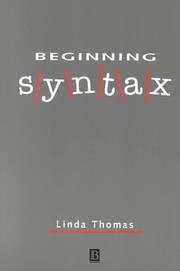 Beginning syntaxThomas, Linda.A methodical, satisfying puzzle-box approach to uncovering the hidden architecture of human language.
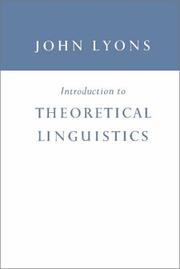 Introduction to theoretical linguisticsLyons, JohnA rigorous, foundational journey into the structural mechanics and theoretical underpinnings of human language.
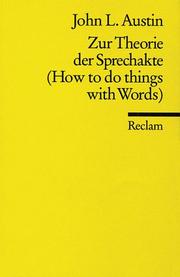 How to do things with wordsJ. L. AustinA witty, methodical dismantling of the idea that words merely describe the world, revealing how they actively construct it.
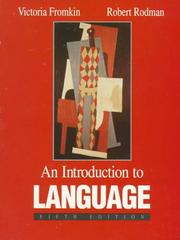 An introduction to languageVictoria FromkinA clear, comprehensive, and deeply curious exploration of the invisible scaffolding that holds human communication together.
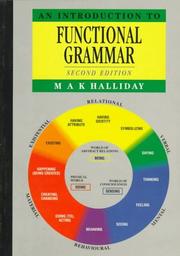 An introduction to functional grammarMichael HallidayA rigorous, paradigm-shifting deep dive into the hidden architecture of how human beings make meaning through language.
 How Language WorksDavid CrystalA delightful, eye-opening tour through the invisible architecture of the words we use every day.