Books › The Signal and the Noise
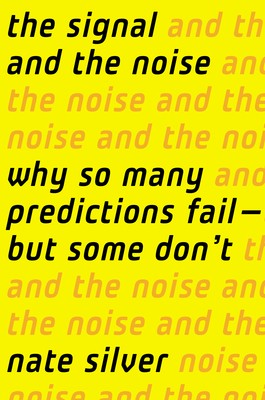
The Signal and the Noise
656 pages
A clear-eyed, intellectually humble journey through the chaotic world of data, teaching you how to spot the truth hidden in the static.
What it feels like
Reading this book feels like sitting down with a brilliant, endlessly curious friend who wants to help you see the world more clearly. The pace is steady and deliberate, taking the time to unpack complex ideas without ever becoming bogged down in academic jargon. It cultivates a mood of cerebral illumination, replacing the anxiety of an unpredictable world with a grounded, pragmatic framework for understanding it. The prose is conversational and accessible, weaving together poker tables, baseball diamonds, and political war rooms to illustrate the profound limits of human knowledge and the danger of overconfidence. It is a deeply satisfying read for data nerds and curious skeptics alike, offering a refreshing dose of intellectual humility and a practical guide to navigating the overwhelming noise of modern life.
- Mood
- cerebral
- illuminating
- grounded
- clear-eyed
- Tone
- analytical
- conversational
- pragmatic
- inquisitive
- humble
- Pace
- steady
- Themes
- navigating uncertainty · cognitive biases · the illusion of certainty · finding truth in chaos · limits of human knowledge
- The writing
- Clear, engaging, and conversational, translating complex statistical concepts into accessible, real-world anecdotes.
- The arc
- Moves from a daunting awareness of human fallibility to a grounded, cautious optimism about our capacity to learn and adapt.
- Who it's for
- Curious skeptics, data enthusiasts, and anyone fascinated by why experts fail and how we can make better decisions in an unpredictable world.
Content notes
- references to natural disasters
- references to the 2008 financial crisis
- references to the 9/11 terrorist attacks
About the book
Nate Silver built an innovative system for predicting baseball performance, predicted the 2008 election within a hair’s breadth, and became a national sensation as a blogger—all by the time he was thirty. The New York Times now publishes FiveThirtyEight.com, where Silver is one of the nation’s most influential political forecasters.
Drawing on his own groundbreaking work, Silver examines the world of prediction, investigating how we can distinguish a true signal from a universe of noisy data. Most predictions fail, often at great cost to society, because most of us have a poor understanding of probability and uncertainty. Both experts and laypeople mistake more confident predictions for more accurate ones. But overconfidence is often the reason for failure. If our appreciation of uncertainty improves, our predictions can get better too. This is the “prediction paradox”: The more humility we have about our ability to make predictions, the more successful we can be in planning for the future.
In keeping with his own aim to seek truth from data, Silver visits the most successful forecasters in a range of areas, from hurricanes to baseball, from the poker table to the stock market, from Capitol Hill to the NBA. He explains and evaluates how these forecasters think and what bonds they share. What lies behind their success? Are they good—or just lucky? What patterns have they unraveled? And are their forecasts really right? He explores unanticipated commonalities and exposes unexpected juxtapositions. And sometimes, it is not so much how good a prediction is in an absolute sense that matters but how good it is relative to the competition. In other cases, prediction is still a very rudimentary—and dangerous—science.
Silver observes that the most accurate forecasters tend to have a superior command of probability, and they tend to be both humble and hardworking. They distinguish the predictable from the unpredictable, and they notice a thousand little details that lead them closer to the truth. Because of their appreciation of probability, they can distinguish the signal from the noise.
Description from Open Library.
Books like The Signal and the Noise
See why they match SuperforecastingDan GardnerAn intellectually stimulating masterclass in stripping away bias and upgrading your mental software to see the world more clearly.
 The Drunkard's WalkLeonard MlodinowA witty, mind-bending tour through the hidden mathematics of everyday life that will forever change how you view success, failure, and the illusion of control.
 The Theory That Would Not DieSharon Bertsch McGrayneA thrilling intellectual detective story that transforms a single mathematical rule into a centuries-long tale of heresy, codebreaking, and ultimate vindication.
 Fooled by randomnessNassim Nicholas TalebA provocative, intellectual cold shower that shatters your illusions of control and makes you question every success story you have ever heard.
 The Black SwanNassim Nicholas TalebA provocative, intellectually aggressive dismantling of human certainty that will forever change how you look at the future.
 NoiseDaniel Kahneman, Olivier Sibony and othersA methodical, eye-opening exploration of the invisible inconsistencies that secretly govern our most important decisions.