Books › Essay concerning the true original extent and end of civil government

Essay concerning the true original extent and end of civil government
(an essay concerning the true original, extent and end of civil government), and A letter concerning toleration.
321 pages
A methodical, foundational exploration of human rights and the social contract that shaped the modern democratic world.
What it feels like
Reading this foundational text feels like stepping into the intellectual crucible of the Enlightenment. The pace is steady and deliberate, demanding your full attention as it builds its arguments block by logical block. There is a profound, quiet idealism running beneath the formal, seventeenth-century prose, a resolute belief in natural rights, human reason, and the necessity of consent in governance. The mood is deeply contemplative and serious, lacking the fiery rhetoric of a revolution but possessing the quiet, unshakeable authority that sparks them. It is a dense but rewarding experience, perfect for political philosophy enthusiasts and history readers who want to trace the roots of modern liberty, property, and tolerance back to their most influential philosophical source.
- Mood
- intellectual
- contemplative
- serious
- idealistic
- Tone
- analytical
- measured
- persuasive
- authoritative
- earnest
- Pace
- steady
- Themes
- the social contract · individual liberty · the limits of authority · natural rights · religious tolerance
- The writing
- Formal, methodical, and dense with seventeenth-century rhetorical structures, yet remarkably clear in its logical progression.
- The arc
- Moves from a foundational questioning of human nature in a state of nature to a resolute defense of structured, consensual liberty.
- Who it's for
- Students of political philosophy, history buffs, and anyone fascinated by the intellectual bedrock of modern democratic societies.
Content notes
- historical political violence discussed
- seventeenth-century social prejudices
About the book
The central principles of what today is broadly-known as political liberalism were made current in large part by Locke's "Second Treatise of Government" (1690). The principles of individual liberty, the rule of law, government by consent of the people, and the right to private property are taken for granted as fundamental to the human condition now. Most liberal theorists writing today look back to Locke as the source of their ideas. Some maintain that religious fundamentalism, 'post-modernism', and socialism are today the only remaining ideological threats to liberalism.
Description from Open Library.
Books like Essay concerning the true original extent and end of civil government
See why they match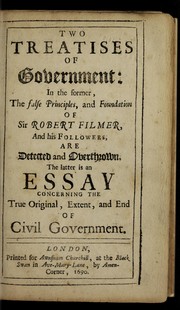 Two Treatises on GovernmentJohn LockeA methodical, foundational exploration of human liberty that dismantled absolute monarchy and laid the intellectual groundwork for modern democracy.
 A Letter Concerning TolerationJohn LockeA foundational, methodical plea for the separation of church and state that champions the freedom of individual conscience.
 LeviathanThomas HobbsA foundational, uncompromising descent into the brutal reality of human nature and the monumental structures we build to survive it.
 Rights of ManThomas PaineA fiery, foundational defense of human dignity that dismantles the divine right of kings with sharp, accessible rhetoric.
 UtilitarianismJohn Stuart MillA rigorous, foundational exploration of what it means to live a good life and build a just society based on the maximization of human happiness.
 Political theoryAndrew HeywoodA clarifying, accessible journey through the complex ideas that govern human societies and shape our political reality.