Books › Types and Programming Languages
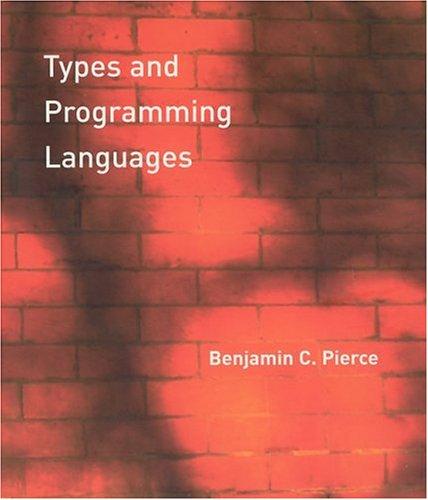
Types and Programming Languages
645 pages
A rigorous, hands-on journey into the logical architecture that underpins modern programming languages.
What it feels like
Reading this book feels like stepping into a meticulously organized workshop where the fundamental building blocks of computation are laid bare. The pace is steady and deliberate, demanding focus as it guides you through a highly structured landscape of lambda-calculus, polymorphism, and subtyping. The mood is deeply intellectual yet surprisingly pragmatic, anchored by a clear, operational prose style that never loses sight of real-world implementation. It is an experience of systematic problem-solving, where theoretical concepts are immediately grounded in programming examples and hands-on exercises. Designed for computer scientists and software engineers, it offers a deeply satisfying journey from basic curiosity to a rigorous mastery of the type systems that secure and define modern software.
- Mood
- intellectual
- structured
- focused
- Tone
- academic
- pragmatic
- rigorous
- instructional
- Pace
- steady
- Themes
- logical structure · pragmatic application · theoretical foundations · systematic problem-solving
- The writing
- Clear, operational, and highly structured, balancing theoretical rigor with practical programming examples.
- The arc
- Moves from foundational curiosity to a deep, structured mastery of complex computational systems.
- Who it's for
- Computer science students, software engineers, and language designers looking for a comprehensive, hands-on guide to type theory.
About the book
A type system is a syntactic method for automatically checking the absence of certain erroneous behaviors by classifying program phrases according to the kinds of values they compute. The study of type systems--and of programming languages from a type-theoretic perspective -- -has important applications in software engineering, language design, high-performance compilers, and security. This text provides a comprehensive introduction both to type systems in computer science and to the basic theory of programming languages. The approach is pragmatic and operational; each new concept is motivated by programming examples and the more theoretical sections are driven by the needs of implementations. Each chapter is accompanied by numerous exercises and solutions, as well as a running implementation, available via the Web. Dependencies between chapters are explicitly identified, allowing readers to choose a variety of paths through the material. The core topics include the untyped lambda-calculus, simple type systems, type reconstruction, universal and existential polymorphism, subtyping, bounded quantification, recursive types, kinds, and type operators. Extended case studies develop a variety of approaches to modeling the features of object-oriented languages.
Description from Open Library.
Books like Types and Programming Languages
See why they match Design concepts in programming languagesDavid Gifford and Mark A. SheldonA rigorous, systematic exploration of how simple frameworks can untangle the immense complexity of programming language design.
 Compilers, principles, techniques, and toolsAlfred V. Aho, Ravi Sethi and othersA rigorous, foundational descent into the deep magic of how human-readable code is transformed into machine execution.
 The C Programming LanguageBrian W. KernighanA masterclass in elegant brevity that feels like being handed the keys to the machine.
 Learning PythonLutz, Mark; Ascher, DavidA comprehensive, patient guide that transforms coding curiosity into structural mastery through deliberate practice.
 The Little SchemerDaniel P. Friedman and Matthias FelleisenA playful, Socratic dialogue that uses food metaphors to rewire your brain into thinking in elegant, recursive loops.
 A grammatical view of logic programmingPierre DeransartA rigorous, deeply cerebral exploration of the mathematical elegance underlying computational logic and formal grammars.