Books › I Am a Strange Loop

I Am a Strange Loop
510 pages
A mind-bending, deeply personal journey into the architecture of consciousness that reveals how we live on inside the minds of those we love.
What it feels like
Reading this book feels like taking a long, winding walk with a brilliant, grieving friend who is trying to explain the universe to you. The pace is meandering and deliberate, looping through playful thought experiments, mathematical paradoxes, and cognitive science before landing unexpectedly in the tender, aching territory of personal loss. It is an intellectually expansive experience that asks you to sit with dense, abstract concepts, but rewards your patience with profound emotional resonance. The prose is conversational yet intricate, building a towering argument about the illusion of the 'I' while simultaneously serving as a beautiful elegy for a lost spouse. It will delight readers who crave philosophy that engages both the rigorous mind and the vulnerable heart.
- Mood
- contemplative
- mind-bending
- poignant
- intellectually expansive
- Tone
- playful
- earnest
- philosophical
- deeply personal
- wry
- Pace
- meandering
- Themes
- the illusion of the self · nature of consciousness · grief and memory · interconnectedness of minds · abstract feedback loops
- The writing
- Conversational and analogy-rich, weaving dense cognitive science and mathematical concepts with tender, vulnerable autobiography.
- The arc
- Moves from playful, abstract intellectual curiosity into a profoundly moving meditation on grief, love, and the persistence of the soul.
- Who it's for
- Thinkers who enjoy having their minds gently bent by philosophical thought experiments and are moved by the intersection of rigorous logic and human vulnerability.
Content notes
- grief
- death of a spouse
About the book
Hofstadter's long-awaited return to the themes of Gödel, Escher, Bach--an original and controversial view of the nature of consciousness and identity. What do we mean when we say "I"? Can a self, a soul, a consciousness, an "I" arise out of mere matter? If it cannot, then how can you or I be here? This book argues that the key to understanding selves and consciousness is a special kind of abstract feedback loop inhabiting our brains. Deep down, a human brain is a chaotic soup of particles, on a higher level it is a jungle of neurons, and on a yet higher level it is a network of abstractions that we call "symbols." The most central and complex symbol in your brain or mine is the one we both call "I." But how can such a mysterious abstraction be real--or is our "I" merely a convenient fiction?--From publisher description.
Description from Open Library.
Books like I Am a Strange Loop
See why they match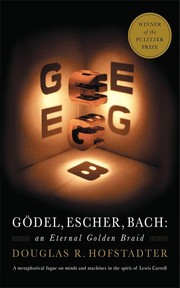 Gödel, Escher, BachDouglas R. HofstadterA dizzying, playful labyrinth of logic, art, and music that fundamentally rewires how you think about thinking.
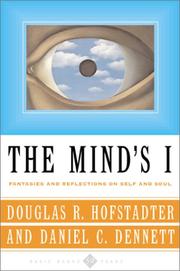 The Mind's IDouglas R. HofstadterA dizzying, playful funhouse mirror of thought experiments that will make you question the very nature of your own existence.
 The society of mindVoyager CompanyA playful, mind-bending puzzle box that dismantles the illusion of the self to reveal the hidden machinery of thought.
 Consciousness explainedDaniel C. DennettA witty, relentless dismantling of the ghost in the machine that will leave you questioning who is actually doing the reading.
 The ego tunnelThomas MetzingerA radical, mind-bending philosophical journey that dismantles the illusion of the self.
 ConsciousnessSusan BlackmoreA dizzying, rigorous dismantling of everything you thought you knew about your own mind and sense of self.